In a previous blog, we discussed the role of Seconds in mysteries. Since Sir Arthur Conan Doyle’s Dr. John Watson really defines the role of an assistant, he deserves his own blog. In fact, he deserves two. So here is part one of our discussion of John Watson’s role as Sherlock’s Second.
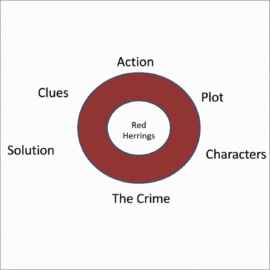
Previously, we defined some common characteristics of Seconds. First, the personality of the Second is often in stark contrast to that of the detective, and his intelligence is not as superior as that of the detective. Next, the Second may occasionally point out flaws to help the reader better understand the detective. However, the Second is a staunch defender of the detective, including putting his own life on the line. Third, our Second may act as a red herring by offering incorrect theories. Fourth, we rely on the Second for information about the case.
If you are only familiar with Nigel Bruce’s movie portrayal of Watson opposite Basil Rathbone’s Sherlock, you may have the impression that Watson is a buffoon who is always on the verge of causing disaster. Not true. Watson is an intelligent and dedicated doctor who served honorably in the Fifth Northumberland Fusiliers as an assistant surgeon. We learn in the first story, A Study in Scarlet, that Sherlock and not Watson is the hero of the tale.
Watson begins creating his secondary role when he describes his service in the Afghan war: “The campaign brought honors and promotions to many, but for me it was nothing but misfortune and disaster.” Hit in the shoulder by a bullet, then stricken with fever, Watson is sent back to England to recover. His funds are limited, and he needs inexpensive lodgings, which leads him to Holmes.
Holmes is working in the laboratory at a hospital, but we learn that he is not studying medicine. He is doing experiments for personal knowledge. 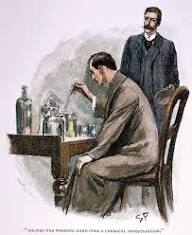
Watson describes Holmes as a little too scientific to the point of “approaching cold-bloodedness.” We are told he would give a friend a pinch of alkaloid not out of malevolence but in the spirit of inquiry. Watson adds that Holmes has no specific profession but a passion for definite, exact knowledge.
We learn that Holmes’ knowledge of literature, philosophy, and astronomy is lacking, and his knowledge of politics is feeble, while his knowledge of chemistry is profound. Botany is variable since he knows about opium and poisons, but nothing about gardening. He is an expert boxer and swordsman and has a practical knowledge of British law. He is good at the science of deduction and analysis, but lacks social skills.
In contrast, Watson easily handles social situations, especially when women are involved. He often provides Holmes with valuable medical information. He is intelligent and maintains a general knowledge of many subjects. But we learn Watson isn’t as good as Sherlock with observation and deductive powers.
Even though Watson has responsibilities as a doctor and later as a husband, he is always willing to take on adventures with Holmes and act as his guardian. Holmes regards Watson as “having someone with me whom I can thoroughly rely.” It’s Watson who keeps his trusty pistol handy in case he needs to protect Holmes. Holmes is also concerned about Watson, and we have a rare glimpse of his reaction when Watson is shot in The Adventure of the Three Garridebs.
In an instant, he had whisked out a revolver from his breast and had fired two shots. I felt a sudden hot sear as if a red-hot iron had been pressed to my thigh. There was a crash as Holmes pistol came down on the man’s head. I had a vision of him sprawling upon the floor with blood running down his face while Holmes rummaged him for weapons. Then my friend’s wiry arms were around me, and he was leading me to a chair.
“You’re not hurt, Watson? For God’s sake, say that you are not hurt!”
It was worth a wound—it was worth many wounds—to know the depth of loyalty and
love which lay behind that cold mask. The clear, hard eyes were dimmed for a moment, and the firm lips were shaking. For the one and only time, I caught a glimpse of a great heart as well as of a great brain. All my years of humble but single-minded service culminated in that moment of revelation.
Watson’s remarks also add definition to the role of a Second when he mentions his “humble but single-minded service.” Watson remains in the background to the great detective but is always available for support and protection.
In the early stories, Holmes is often disappointed with Watson’s abilities at deduction. In fact, Watson’s deductions are often false clues. For example, in The Adventure of the Solitary Cyclist, Holmes belittles Watson’s location for observing the cyclist.
Your hiding-place, my dear Watson, was very faulty. You should have been behind the
hedge, then you would have had a close view of this interesting person. As it is, you were some hundreds of yards away and can tell me even less than Miss Smith.
Holmes then points out that instead of following a clue from a real estate sign, he should have gone to the local pub and listened to gossip. But as the stories continue, Holmes is pleased that Watson’s powers of observation are improving.
And the reader relies on Watson’s observations to tell the story. We know Watson will ask Holmes the questions we want answered about the case. Even Holmes comments about Watson’s chronicling of the stories when he says, “I am lost without my Boswell.” It is Watson’s accurate descriptions of characters, locations, and clues that enable us to solve the case alongside Sherlock.