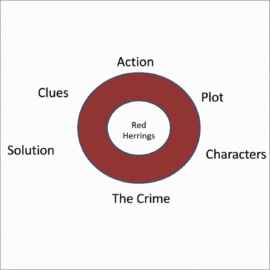
What is a red herring? On the simplest level, it is a kipper or a herring fish that is heavily salted and smoked. This process turns the fish red and gives it a pungent smell.
How did the term red herring come to mean throwing one off the scent? Some will dispute the origin, but I will share this story with you because it makes sense.
Fox hunters used red herrings to train young hunting dogs to follow a scent. Once the dogs followed the strong fish smell, they substituted the lighter scent of a fox or a rabbit. The red herring was crisscrossed through the animal scent to throw the dogs off as a final step in the training process. The dogs were ready to hunt when they could ignore the red herring and follow the true scent.

In mysteries, a red herring refers to a clue or even a character designed to throw the reader and the detective off the scent of the real culprit. A mystery often cited as one of the best using red herrings is Agatha Christie’s Murder on the Orient Express. Hercule Poirot discusses the red herring during his solution of the case:
“Further to confuse the issue, a red herring was drawn across the trail—the mythical woman in the red kimono. Again, I am to bear witness to this woman’s existence. There is a heavy bang at my door. I get up and look out—and see the scarlet kimono disappearing in the distance.”
Christie’s story goes beyond the incident of the red kimono. Unlike some stories with a single red herring, the entire story is about red herrings designed to mislead Poirot, making this mystery unique. Let’s take a closer look at some of Christie’s red herrings.
- Ratchett, the victim, screams out in the night. He states in French that he had a nightmare, but Ratchett spoke no foreign languages. Does the French phrase point to the conductor, Pierre Michel, or Ratchett’s secretary, Hector MacQueen, or perhaps a stranger?
- Ratchett received threatening letters—do the letters point to passenger Antonio Foscarelli, who might have mob connections, or does it mean someone hired an assassin?
- A conductor’s uniform button found in Ratchett’s compartment points to Pierre Michel, or was there another conductor in the car?
- Another passenger, Mrs. Hubbard, reports a male intruder in her compartment.
- Hubbard finds the murder weapon in her compartment. Did the intruder leave the weapon as he escaped from the dead man’s compartment?
- The Maid, Hildegarde Schmidt, states that she passes a small, dark man in a conductor’s uniform who is a stranger.
- And back to the red kimono—reported to be a tall woman, but could it have been a man?
Many other clues, like the pipe cleaner or the dainty embroidered handkerchief, cast suspicion on different passengers. The red herrings are directing Poirot to a stranger who has entered the train disguised as a conductor and escaped, perhaps as a woman wearing a red kimono. But just like the hunting dogs, Poirot ignores the strong smell of the herrings and finds the true scent to solve the case.
What’s your favorite mystery with a red herring?