It’s amazing how quickly twenty-five years can pass, especially when it involves a good mystery series like Poirot. It’s hard to believe the last episodes featuring David Suchet as Hercule Poirot finished in 2013.
The star filmed 70 episodes based on the 33 novels and dozens of short stories featuring Agatha Christie’s odd little detective. The first show premiered in 1989 with The Mysterious Affair at Styles and ended with Christie’s final Poirot tale, Curtain.
Who Is Hercule Poirot
Christie drew inspiration for her detective from the Belgian refugees arriving after WW I. She also admits that she followed the format established by Arthur Conan Doyle for his Sherlock Holmes stories. Like Holmes, Poirot is an eccentric and egotistical detective.
Christie added Captain Hastings, the “Watson-like” storytelling assistant, who was constantly amazed and confounded by the detective’s capabilities. And don’t forget the Scotland Yard Inspector, Japp, who relies on Poirot to spot the essential clues that have slipped by him.
Christie may have initially followed the Doyle format; however, she developed an intriguing detective of her own. He had his distinctive personality and unique methods for solving crime. Poirot believed that “the truth had a habit of revealing itself” and felt in his brain within “the little grey cells lies the soul of every mystery.”
The reader soon discovers that Poirot’s characteristics and habits make him stand out from all the other detectives. This is how Arthur Hastings first describes Poirot in The Mysterious Affair at Styles;
…an extraordinary-looking little man. He was hardly more than five feet four inches, but carried himself with great dignity. His head was exactly the shape of an egg, and he always perched it a little on one side. His moustache was very stiff and military. The neatness of his attire was almost incredible; I believe a speck of dust would have caused him more pain than a bullet wound.
One of the keys to understanding Poirot’s character is in his moustache. He demonstrates a meticulous method for caring for them and applies this same method for solving crime.
Christie’s View of Poirot
Christie once commented that she wished she had created a younger Poirot so they could have grown old together. While Christie never mentions his specific age, it is evident that Poirot is older and set in his ways.
Christie was not a fan of her detective and called him many names, including bombastic, egocentric, detestable, tiresome, and odd. Regardless of her personal dislike, Christie felt that if her public enjoyed Poirot, she would continue to feature him in her stories.
The Last Story
The final Poirot book, Curtain, was kept in a bank vault with the understanding that the family would not release it until after Christie’s death. However, Christie released the book in 1975. In this story, Poirot solves one last case before his death. Just before the publication of Curtain, The New York Times printed a front-page obituary in memory of Hercule Poirot.
“Hercule Poirot Is Dead: Famed Belgian Detective
Hercule Poirot, a Belgian detective who became internationally famous, has died in England. His age was unknown. Mr. Poirot achieved fame as a private investigator after retiring from the Belgian police force in 1904. His career, as chronicled in the novels of Dame Agatha Christie, was one of the most illustrious in fiction.
At the end of his life, he had arthritis and had a bad heart. He was in a wheelchair often, and was carried from his bedroom to the public lounge at Styles Court, a nursing home in Essex, wearing a wig and false moustaches to mask the signs of age that offended his vanity. In his active days, he was always impeccably dressed.
The news of his death, given by Dame Agatha, was not unexpected. Word that he was near death reached here last May. Dame Agatha reports in “Curtain” that he managed, in one final gesture, to perform one more act of cerebration that saved an innocent bystander from disaster. “Nothing in his life became him like the leaving of it,” to quote Shakespeare, whom Poirot frequently misquoted.
Poirot’s Portrayer
The family approved David Suchet to take on the role. And the critics seem to agree that he is the consummate Poirot. When the audience looks at Suchet, they see the Poirot they imagine from the books and stories.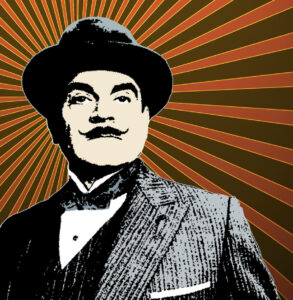
Christie may have built a particular personality for her odd little detective, but Suchet and the series have allowed subtle enhancements to expand his defined characteristics. For instance, over the seventy episodes, they allowed Poirot to age. His moustache is thinner and grayer, and his walk has slowed, with a noticeable stiffness. His gourmet diet and his fondness for Belgian chocolates have gradually added to his waistline.
We may not find much emotion in the written word, but Suchet has added little touches of sentiment to his portrayal. Christie always gives Poirot his big moment on stage when he gathers all the suspects for the reveal. In Suchet’s performance, we can see the anger and disgust he expresses toward the murderer for taking a life.
We witness other emotions with Suchet’s portrayal. There is a twinkle in his eye when he puts one over on Hastings and a special smile in appreciation for Miss Lemon’s office skills. But even deeper emotions occasionally seep in. We see the sadness of what might have been as Poirot says his farewell to the Countess Rossakoff in The Double Clue, or the sincere pleasure in The Chocolate Box episode when Poirot discovers one of his friends named his son after him. And could that be a tear in Poirot’s eye as he stands next to Ariadne Oliver and realizes the power of love at the end of The Third Girl episode?
While we have these little additions to the character, make no mistake, the series doesn’t waiver on Poirot basics. For example, even though they are entirely out of fashion, Poirot continues to wear spats and uses pince-nez for his reading glasses. And throughout the series, the ‘greatest detective’ relies on his little gray cells to solve the crime.
Good News–There’s More to Come
Before we all go into Poirot withdrawal, there is hope. The family has authorized new Poirot books from Sophie Hannah, starting with The Monogram Murders. There is yet another story for devoted Poirot fans to read. And who knows, perhaps another show will be filmed.
But for now, Goodbye, Poirot—thank you, David Suchet—and Dame Agatha Christie.