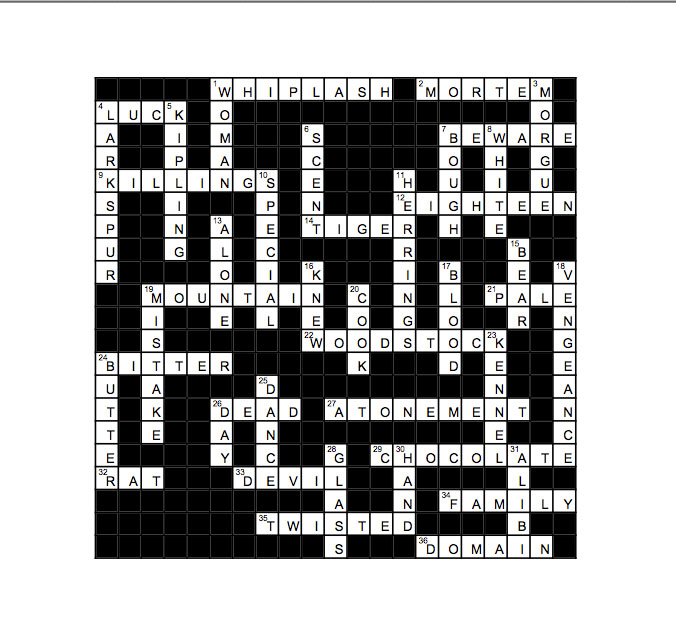
Here you go! Here is the solution to last week’s word search of Nero Wolfe titles. I’m sure you don’t need the help, but just in case …

Here you go! Here is the solution to last week’s word search of Nero Wolfe titles. I’m sure you don’t need the help, but just in case …
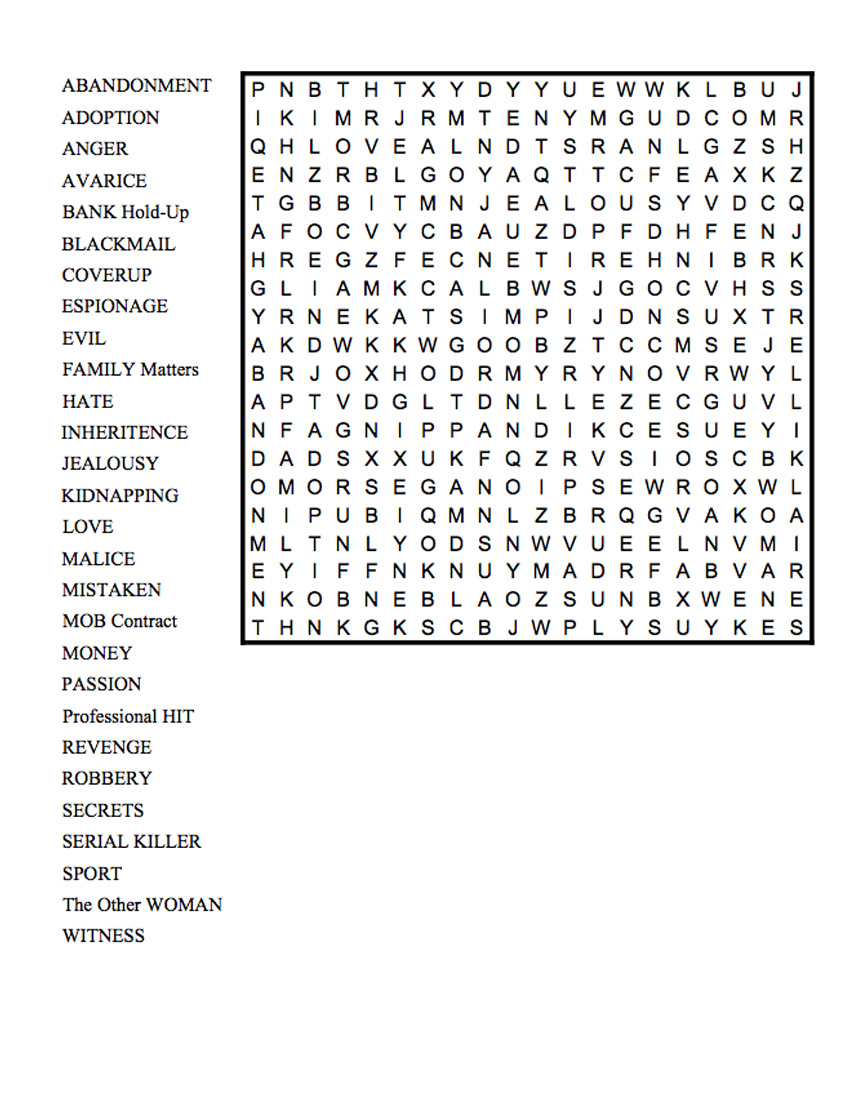
Rex Stout wrote 33 novels and 39 short stories over four decades featuring his detective Nero Wolfe and his assistant Archie Goodwin. Listed below are titles from many of the novels. See if you can find the words listed in capital letters. Solution will appear next week.

Previously in our discussion of Golden Age detectives we learned that these detectives have characteristics that cause them to stand out from the average person. These characteristics can be in the form of quirks, habits, hobbies or even physical appearance. And what better example of a detective that stands out from the crowd than Nero Wolfe created by Rex Stout. What makes Wolfe different from others?
First Wolfe is a very, very large man. Archie Goodwin, Wolfe’s assistant and narrator of the stories describes Wolfe as weighing a seventh of a ton. Then throughout the narratives Archie makes constant references to Wolfe’s rotund size and his lack of movement. Even Wolfe makes a point of his weight when he explains why he doesn’t stand to great a visitor to his office: Mr. Kimball, you will forgive me for not rising; I am not rude, merely unwieldy.
There are a couple of other elements which emphasize the weight factor. Wolfe uses an elevator to go between floors of his house rather than take the steps. And then there is the alarm set-up in Wolfe’s bedroom that rings a gong in Archie’s room should anyone approach the door. Archie states that the alarm exists not because Wolfe is a coward, but he has an intense dislike for being touched by anyone or for being compelled without warning to make any quick movements. And imagine the intruder’s surprise when he finds Wolfe in yellow silk pajamas resting between yellow sheets?
Wolfe is a gourmet who loves food and has a live-in chef, Fritz Brenner. He takes part in the food discussions and preparations of his meals. Of course eating all this rich food adds to the visual of his immense size. And if a gourmet meal was not enough Wolfe spends his evenings drinking beer.
Let’s talk about beer! During prohibition Wolfe bought his beer in bootlegged kegs and drank it by the pitcher. After prohibition Wolfe switches to bottled beer. In fact in the opening chapter of the first book Fer-de-Lance Wolfe has dozens of samples brought in for tasting so he can select a suitable brand of bottled beer. He drinks a minimum of five bottles of beer each night and tracks his consumption by placing the bottle caps in his top desk drawer. Archie returns to the office one day to find the desk covered with bottle caps that Wolfe is stacking and counting.
Nero Wolfe deals with very gruesome murders, but these crimes are balanced by a defined order for the events in his everyday life. Wolfe has a daily schedule that he follows religiously even when there is breaking news concerning the case. He has breakfast in bed. Then he proceeds to his rooftop greenhouse where he tends his orchids from 9:00 until 11:00 a.m. and then again in the afternoons from 4:00 to 6:00 p.m. Lunch is at 1:00 pm and dinner at 8:00 p.m. Wolfe does not allow business discussions to interrupt his meal times. Interviewing clients and witnesses, meeting with the police, reviewing case notes with Archie and solving crimes are restricted to the remaining hours of his day.
Wolfe also has a fetish about leaving his house and rarely does. There are some occasions when Wolfe has left the comfort of his brownstone such as in The Black Mountain where he returns home to Montenegro to solve the murder of his best friend and in Some Buried Caesar where he is on his way to an orchid show and gets sidetracked with a case about
a prize bull. However, for the reader there is comfort in knowing that Wolfe is at home working on the case.
Of course we would be remiss if we did not mention Wolfe’s love or orchids. He grows 10,000 plants in his rooftop greenhouse that he maintains with gardener Theodore Horstmann. He often sends client orchids and when Wolfe leaves his greenhouse for his office hours he brings a fresh orchid for his desk.
And what about the cases? We are given access to all the interviews and all the information gathered by Archie for Wolfe. We watch the preparation and execution of Wolfe’s elaborate schemes carried out by Archie, Saul Panzer, Orrie Cather and Fred Durkin designed to catch the criminal. We sit with Archie and watch as Wolfe closes his eyes and goes into a trance to ponder the facts of the case and we try like Wolfe to sift through all the information. But somehow Wolfe possesses a unique insight and is always one step ahead. He can discern from the smallest piece of information an enormous clue that solves the case. And like Archie we are often amazed at the results.
The Wolfe-Goodwin stories are also more lighthearted than other mysteries due to the constant banter between Archie and Nero. Archie is constantly prodding Wolfe to either take action or explain his actions.
Wolfe wiggled a finger at me. “Compose yourself Archie. Why taunt me? Why upbraid me? I am merely a genius, not a god.”
There were times when Wolfe’s awful self assurance gave me a touch of a dash of a pain in the neck, but there were other times when it was as good as a flock of beautiful maidens smoothing my brow.”
It is this father-son relationship and Archie’s jaunty writing style that makes these stories fun to read.
Nero and Archie don’t age throughout the entire series of 33 books and 30 short stories. But readers don’t seem to mind that they are locked in a particular period of time. In fact there seems to be a bit of comfort in knowing the routine and the habits of the detective duo.
Wolfe mysteries are a combination of the English style cozy with Wolfe sitting comfortably in his home and sorting through the clues and the hard boiled detective exemplified in the work that Archie does. We see the stories from two points of view; the young and energetic student and the sedentary wise master. Archie and Nero are indeed an odd combination, but in the end it works and provides a delightful read.
(Note: Quotes are from the first Wolfe novel Fer-de-Lance –1934)
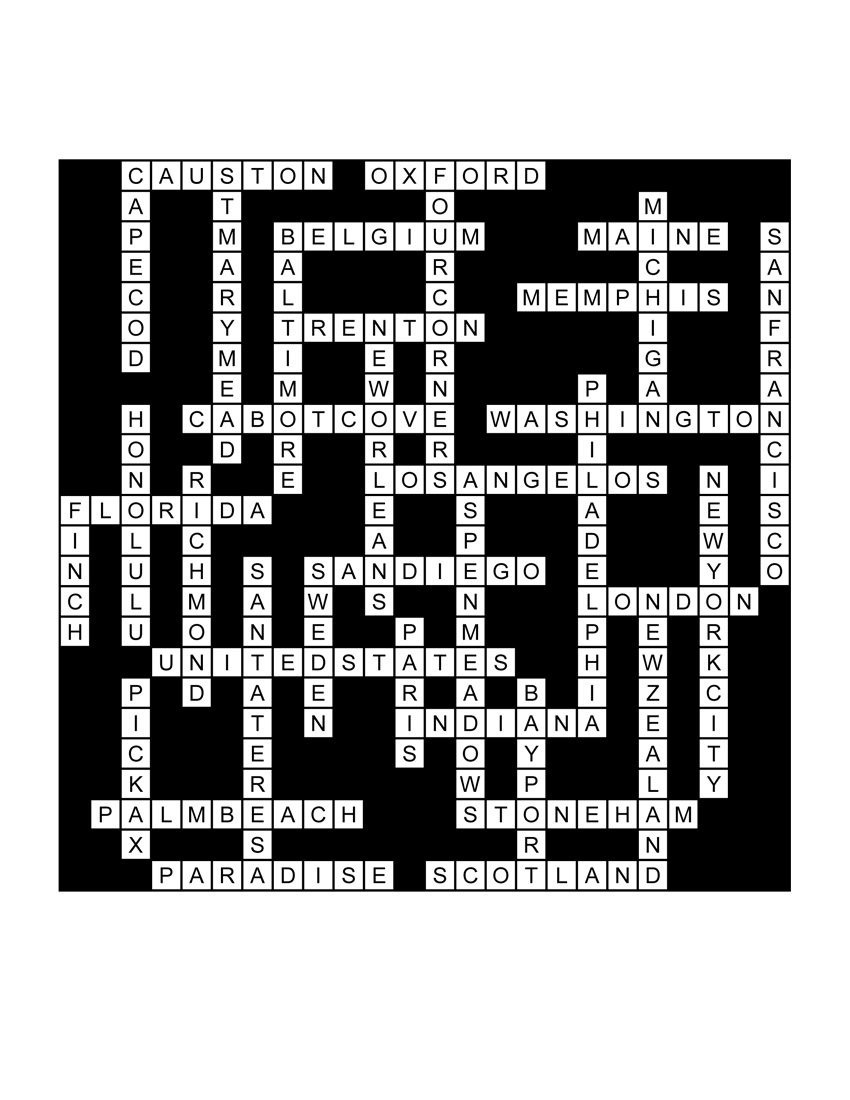
Were you able to fill in all the answers for the country, state or city our mystery authors call home? How did you do with listing the detective’s location for crime solving? In case you have some doubts here is the solution.
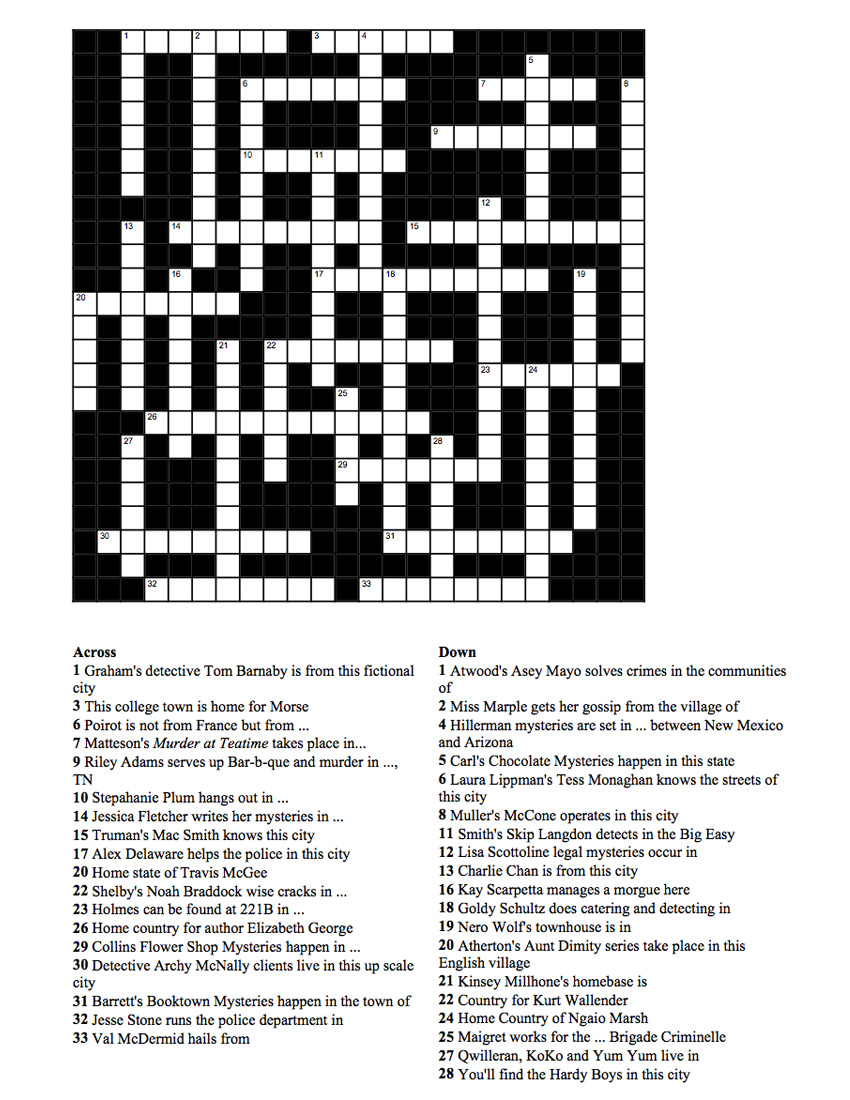
Do you know the country, state or city your favorite mystery author calls home? How about the location where the detective resides and solves crime? Test your knowledge on this subject with this crossword puzzle featuring some popular authors and detectives. The solution will be published next week.
Recently I needed to move parts of one chapter to another section of a mystery book I’m writing. I realized as I completed the task how easy it is to make these changes with a computer.
I’m old enough to remember typewriters. Does that sound like a strange statement? Remember, many of our younger readers don’t know about typewriters and are growing up in the age of technology.
And no, I’m not about to tell you that I still write everything on an old typewriter that I’ve had in my family for years. Of course I mean no disrespect to the writers who write on one of these machines. Instead I will tell you that I love my computer.
I have a small laptop computer called a netbook that weighs next to nothing and goes anywhere I go. It snuggles against me when I carry it and has become a good friend. I can turn it on at a moment’s notice to capture my thoughts. I can save multiple versions of these thoughts and I can edit my writing as many times as I want without having to retype entire pages. I can change styles and fonts and I can italicize, superscript, underline and even bold with the click of a button.
Of course as a mystery lover I started to think about my netbook in a different way. The computer is a wonderful instrument for committing a crime. It’s so much easier to perform evil deeds and even a murder with a computer.
Here is what I mean when I call it an evil and murderous tool. I can add a character to my story and then if I don’t like what they are doing or how they are acting I hit the delete button. They are gone-eliminated-dead! They have vanished without a trace.
The computer is also a great weapon when I don’t like what a character says. If I think the character is going too far and about to give away the ending, I just tap the back arrow key and stop them from spilling their guts and revealing the solution.
The computer also allows me to modify all types of murder weapons. I type the word knife. Then with a few keystrokes I can make it a hunting knife, a pocket knife, a fillet knife or an antique knife. I can make the blade long, short, dull, sharp or pointed. I can have a wooden handle, a pearl handle or a handle laden with exquisite jewels stolen from a royal family. And of course I can have it dripping with blood or wiped clean and glistening next to a dead body.
Best of all if I write a chapter where the red herrings and the clues aren’t working, off to the recycle bin it goes. But wait, I’ve changed my mind and that clue is important to solve the puzzle. I really need to include it in the story so I open the recycle bin and the chapter magically reappears. Killed the wrong person –just bring them back to life from the bin.
I guess you could kill someone with a typewriter by hitting the person over the head. (Hmm actually that’s a good idea for the next “Methods of Murder” word search puzzle.) But the netbook is so much more sophisticated and so very quiet for committing a murder. It’s a delightfully mysterious and murderous tool for crime writing.
Let me apologize in advance that this blog is not meant to insult all the wonderful male writers and readers of mysteries, but…
Why are the majority of mystery writers and readers women? The easy answer might be that since woman buy more mysteries than men, woman writers are better able to provide what women are looking for in their stories. I say this because according to a recent study released by Sisters in Crime 68% of all mysteries are purchased by women.
Another answer might be the popularity of Cozy mysteries which we discussed in our last blog. Cozies are one of the largest sub-genres of mysteries and as we learned they feature an amateur detective that is usually a woman. We enjoy following a fellow woman who is in charge and capable of solving a complex puzzle.
But aside from our love of mysteries, I wonder if it doesn’t have more to do with the personality differences of men and women. Another recent study indicates emails from men are very short and to the point, while emails from women are much longer. I think this tendency to share more information benefits women when writing mysteries.
Mystery writing requires a complete story. We want a story that guides us from the beginning to the end. We want all of the facts and we want to know all the clues before the ending is revealed. We want to know how the pieces of the puzzle fit and we don’t like unanswered questions. Finally we want the ending to be logical with no surprises. And women seem to have the upper hand when working with lots of information and tiny details.
Women are also known for their caring and nurturing ways. As a result, we like to learn about the characters and get into their heads to understand what makes them tick. We like characters that we can identify with or at the very least understand why they act the way they do. And we’ll take a good character over violence, gory details and even suspense.
Then there is the emotional factor. Women are often accused of allowing emotions to prevail. But when it comes to mysteries women detectives often rely on their feelings and intuitive sense to solve the murder. We hold true to the principles of justice being served, however that doesn’t mean we don’t have feelings for the criminal. We want to understand their motives for the crime.
And last but not least, there is the murder. Since we must balance the principals of law with our emotions, mysteries help satisfy our desire to eliminate those who are evil. Maybe we have a secret desire to murder people we don’t like and mysteries help fulfill this need. It’s fun to come up with delicious ways to murder the victims. (Check out the word search puzzle blog “Methods of Murder” which offers multiple ways to eliminate someone.)
So these are my thoughts. What are your thoughts on why women buy, read and write more mysteries?
We recently looked at Agatha Christie and her writing style and how she generally followed the rules from the Golden Age of Mysteries. Christie was definitely part of the Golden Age, but she is also listed as one of the prime examples of “Cozy” mysteries. So what is a Cozy mystery?
Cozy mysteries or “Cozies” first appeared in the late 20th century to revitalize some of the elements of the Golden Age mysteries. And many of today’s popular mysteries fall into the category of a Cozy. It’s one of my favorite categories and the mystery I’m writing is also a Cozy. What are the characteristics of this type of mystery?
First, just as with a Golden Age Mysteries all clues must be presented so the reader has a fair and equal opportunity to solve the crime. There can be the usual assortment of red herrings, but the true clues must all be presented and available for the reader to use to find the solution.
Cozies are often called “bloodless” crimes because violence, blood and gory facts are not described in detail. In many cases the body is discovered by someone other than the detective and it’s after the discovery of the body that the detective gets involved. For instance Miss Marple in Christie’s The Mirror Crack’d from Side to Side is at home with a foot injury when the murder occurs. It’s the other characters in the story who described the crime and bring Miss Marple the information she needs to solve the murder.
Small town atmosphere is another important element of a Cozy. In Atherton’s Aunt Dimity series, Lori Shepherd does her sleuthing in and around the small English village of Finch. As readers we learn the customs of the village and get to see the interactions between the residents and possible suspects. Sometimes the antics of village life can be a distraction, but nestled in the daily happenings are the clues.
What are the characteristics of the typical crime solver in a Cozy. The detective is an amateur and most often a woman. Since the detective is an amateur they have other professions or interests such as inn keeper, shop owner, caterer, professor or reporter. Frequently, it is their business/profession that is adversely affected by the murder and that is their motivation to solve the crime. For Instance in JoAnna Carl’s The Chocolate Cat Caper, Lee McKinney has to protect her Aunt’s chocolate business when a high profile lawyer dies after eating one of her aunt’s chocolates that is laced with cyanide. Cozy detectives just like McKinney are on the scene and know the participants and therefore are the ones most likely to find the culprit. Plus, Cozies often center on popular subjects such as cooking, antiques, chocolate, coffee, wine, art, pets and books to name a few.
Cozies, unlike the Golden Age mysteries allow romance in the story. However, the romance is never described in explicit detail. Plus, it cannot interfere with and must be secondary to solving the crime. Goldy Schulz has her Tom and Jim Qwilleran has his Polly, but these relationships assist rather than hinder the solving of the mystery.
Here are some other features common to Cozies:
Cozies are comfortable especially on those days when we want to curl up with a good
book. We won’t be scared or horrified by the gory details, but we will be challenged by a first-rate puzzle to solve. And at the end of the book we will feel good because the crime has been solved and justice prevails.
I’m sure there are many Cozy titles on your mystery book list that you can’t wait to read. In fact today is one of those days when I’m going to curl up with a good Cozy.
(Note: Quotes are from The Tuesday Club Murders unless otherwise indicated.)
One of Agatha Christie’s most beloved characters is an old lady—Miss Jane Marple. But an old lady who is sharp as a tack and applies her years of experience to solving some very unique murders.
Christie in her autobiography stated in hindsight she wished she had made both Poirot
and Miss Marple younger.
“Miss Marple was born at the age of sixty-five to seventy–which as with Poirot, proved
unfortunate, because she was going to have to last a long time in my life. If I had had any second sight I would have provided myself with a precocious schoolboy as my first detective; then he could have grown old with me”
In addition to being elderly, Miss Marple is initially described in her first book,
The Murder at the Vicarage, as a village busybody who knows everyone’s business.
“She’s the worst cat in the village,” said Griselda. “And she always knows every single thing that happens—and draws the worst influences from it.”
As her character develops in subsequent books her “nosy parker nature” changes to simply being curious and takes a secondary position to her interest in human nature. She becomes kinder and gentler and a little more modern as the books progress. Let’s take closer look at Miss Marple and learn through quotes from her and about her.
Miss Marple’s Description
Over the years several different actresses have played Miss Marple so we may all have
different impressions of what she looks like. But here is Christie’s description of her.
“Miss Marple wore a black brocade dress, very much pinched in around the waist. Mechlin lace was arranged in a cascade down the front of the bodice. She had on lace mittens, and a black lace cap surmounted the piled-up masses of her snowy hair. She was knitting—something white and soft and fleecy.”
We get a different view when the description of two dinner guests is presented in The
Murder at the Vicarage.
“Miss Marple is a white-haired old lady with a gentle, appealing manner—Miss
Weatherby is a mixture of vinegar and gush. Of the two Miss Marple is much more
dangerous.”
Has your mental picture changed of what she looks like? Do we have an accurate
picture of this elderly lady? Let’s see what else we can learn about her.
Miss Marple is Often Ignored
Because of her age it is assumed she is not up with the times and therefore she is often ignored. However, while people are ignoring her she is carefully observing them. Even Miss Marple mentions her ability of observation– Now fortunately I am in the habit of observing closely.
Eventually others become aware of her. Here is a quote from Henry Clithering concerning Miss Marple’s role in the Tuesday Night Club. The club consists of a group of friends who meet every week where one member presents a mystery for the others to solve.
“—we hardly realized that Miss Marple was playing; but we were polite about it—didn’t want to hurt the old dear’s feelings. And now comes the cream of the jest. The old lady out did us every time.”
Knitting Helps Solve Crimes
After all when discussing something as intense as murder why would anyone pay any attention to someone quietly knitting in a corner? This is how Miss Marple views her knitting: Sitting here with one’s knitting one just sees the facts. Don’t you be fooled–she is making mental notes of how the characters/suspects mirror someone or some incident in her village of St. Mary Mead
Village Life
Miss Marple has rarely left her village during her entire lifetime. What could she
possibly know about the wicked world outside St. Mary Mead?
“The only thing I ever said was that human nature is much the same in a village as
anywhere else, only one has opportunities and leisure for seeing it at closer quarters.”
“There is a great deal of wickedness in village life.”
She goes on to say that the same types of people and behaviors she observes in a
village repeat themselves outside the village. People tend to be the same everywhere.
“Human nature is always interesting, Sir Henry. And it’s curious to see how certain types always tend to act in exactly the same way.”
Often others find her stories about an incident in the village totally unrelated to the topic under discussion. So while they indulge her little ramblings, they are suddenly surprised that her little tale is the clue that solves the crime.
The Value of Gossip
Even though Miss Marple has been called a busy body, meddlesome, a nosy-parker, etc,
she defends the value of gossip especially in village life.
“I’m afraid observing human nature for as long as I have done, one gets not to
expect very much from it. I dare say the idle tittle-tattle is very wrong and unkind, but it is so often true, isn’t it?”
“Surely the whole crux of the matter is this: How often is tittle-tattle, as you call
it true! And I think if, as I say, they really examined the facts they would find that it was true nine times out of ten! That’s really what makes people so annoyed about it.” (The Murder at the Vicarage)
Criminals Must Be Brought to Justice
While Miss Marple might be knitting something soft and fleecy, she is no “softie”
when it comes to bringing criminals to justice.
“Sanders was hanged,” said Miss Marple crisply. “And a good job too. I have never regretted my part in bringing that man to justice. I’ve no patience with modern humanitarian scruples about capital punishments.”
So what can we say in summary of this elderly detective who always seems to find the truth among all the facts and clues presented. It seems that while others, including the police, fumble and are mislead this dear, sweet woman ultimately solves the crime. Here are two more quotes from The Murder at the Vicarage.
“For all her fragile appearance, Miss Marple is capable of holding her own with any policeman or Chief Constable in existence.”
“There is no detective in England equal to a spinster lady of uncertain age with plenty of time on her hands.”
There is no detective anywhere quite like Miss Marple. She continues to entertain mystery enthusiast today and no doubt for a long time to come.
Just in case the Grand Dame of mysteries was able to fool you–here are the clues to the puzzle!
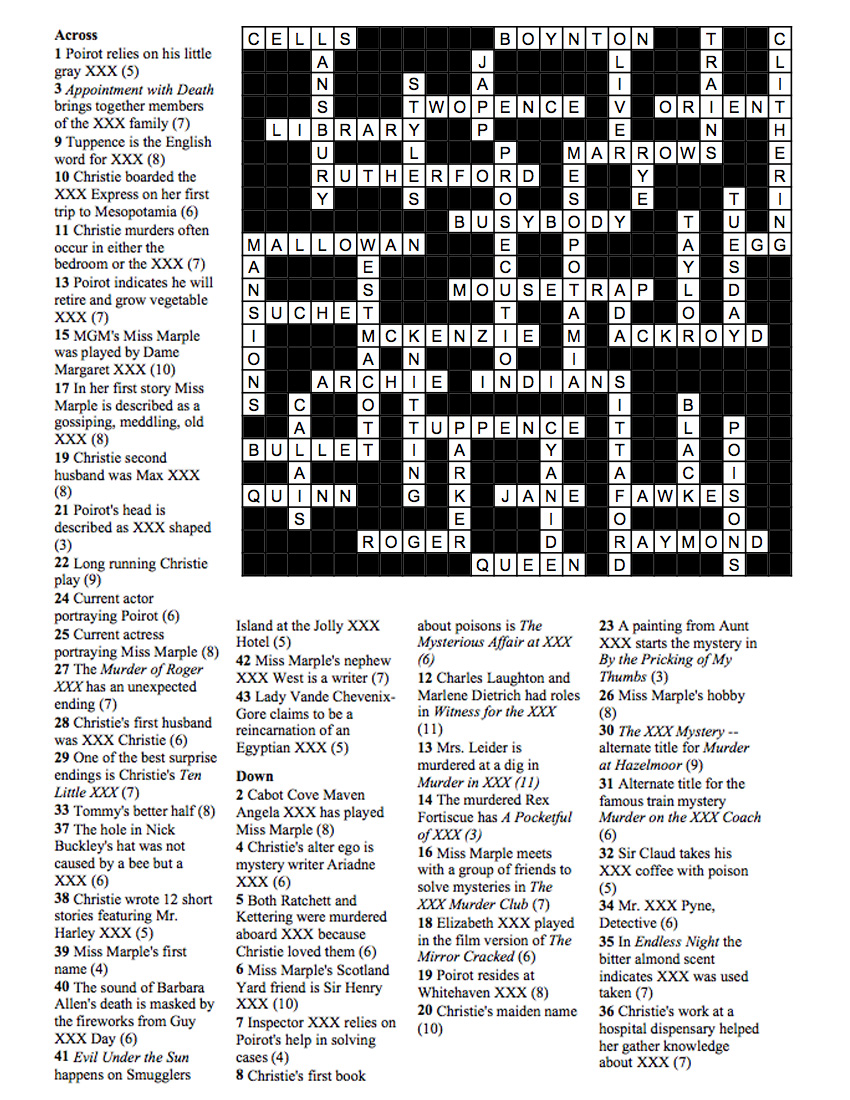
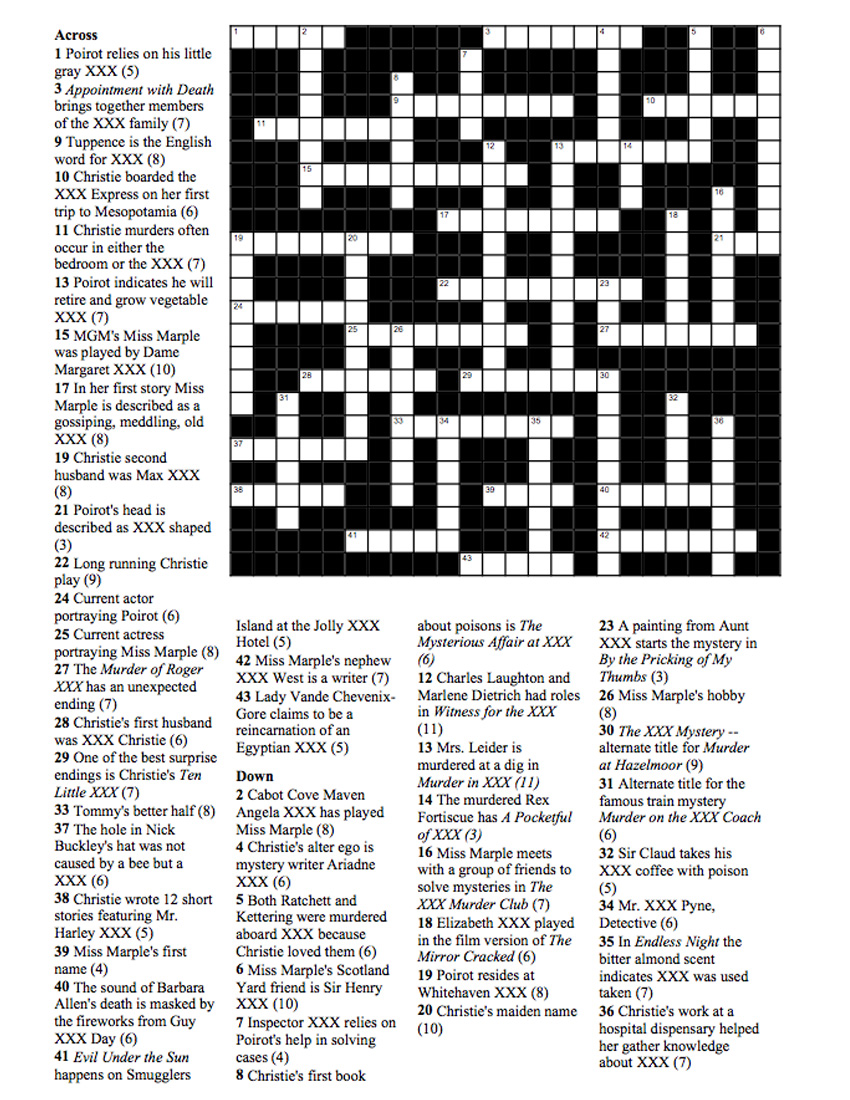
Agatha Christie remains one of the most popular mystery authors in history. How much do you know about the author, her writings and her characters? Look for the solution next week
I never grow tired of reading Agatha Christie. Each time I read a Christie mystery I find something new–some hidden clue, some nuance that I missed the first time. Characters are so interesting and the plots so intricate that I can’t discover everything with the first read. There is always some piece of information about the suspect’s behavior or some slip of the tongue or some clue that I miss.
Agatha Christie was one of the authors from the Golden Age of Mysteries and generally followed the rules from this period as previously discussed in an earlier blog. She wrote more than 80 crime novels, half a dozen romance novels and several plays. How did Christie create all these plots for her books? In her autobiography she stated:
Plots come to me at such odd moments; when I am walking along a street, or examining a hat shop with particular interest suddenly a splendid idea comes into my head, and I think “Now that would be a neat way of covering up the crime so that nobody would see the point.” Of course all the practical details are still to be worked out, and the people have to creep slowly into my consciousness….
Christie’s people/characters are complex and her detectives are great observers. They are the ones that spot the minute details that lead ultimately to the solution. For example in Death in the Clouds Poirot requests to see the list of what each passenger had with them on the plane. Many of us readers are fooled by the emphasis on the blow guns and the wasp and miss the real clue of…wait…no I won’t tell you and spoil the ending. However, Poirot is not fooled and spots the meaningful items. Poirot ponders his observations and formulates his conclusions by having quiet time with his “little gray cells.”
Miss Marple on the other hand relates her observations to the people of St. Mary Mead. In Blue Geraniums she compares her local gardener killing wasps to the current crime and solves how the murder was accomplished. Miss Marple defends her comparisons to the people in St. Mary Mead when she states in the Tuesday Club Murders that “human nature is very much the same everywhere, and, of course, one has the opportunities of observing it at closer quarters in a village.”
Christie’s mysteries focus on the British middle and upper class–the class that never breaks into a sweat and is known for hiding their emotions. Therefore Christie does not sensationalized the murder by describing the blood and gore aspects of the death. She spends her time describing the scene and the people. For example in The ABC Murders the murder of Mrs. Ascher is described in three sentences but we have many pages describing the street outside, the murdered woman’s shop and a very complete description of her bedroom and the items in it.
However, while the murder may not be sensationalized make no mistake there is a passionate desire in Christie’s books to bring the murderer to justice and her detectives do not fail us. They follow the clues, they interview the suspects and they use their own brand of unique logic to uncover the culprit.
And finally, Christie deserves a second read because of her ability at deception. First, there is the usual assortment of red herrings such as in The ABC Murders where we believe stockings are an important clue and they are, but not in the way we initially think. Second, is her use of multiple suspects as in Murder on the Orient Express where anyone in the sleeping car could have committed murder. And finally, her plots are truly clever and her murders very inventive. One needs only to look at And Then There Were None as a perfect example of her cleverness as each potential suspect is gradually eliminated and the deception continues until the very end.
So these are all the elements about a Christie mystery that make it difficult to comprehend the first time. The characters, the plot, the deceptions and the clues are clearly presented to us, nothing is hidden. But because she is such superb story teller there is so much for us to grasp. Don’t you agree that Christie mysteries deserve a second read?
What do the names listed below have in common?
G.K. Chesterton, Mary Roberts Rinehart, Agatha Christie, Earl Derr Biggers, Patricia Wentworth, Rex Stout, S.S. Van Dine, Dorothy Sayers, Dashiell Hammett, Ronald Knox, Phobe Atwood Taylor, Ngaio Marsh, Lucy Beatrice Malleson, Gladys Mitchell, Georges Simenon, Margery Allingham, Ellery Queen, Raymond Chandler, Stuart Palmer, and Leslie Charteris
A very impressive list and there are many more names I didn’t mentioned. And of course you are absolutely correct they are all mystery authors. But did you know they are also all authors from what is called the “Golden Age of Mysteries.”
The Golden Age of Mysteries was at its peak during the 20’s and 30’s but the format for these mysteries continues today. What are the rules for these mysteries that include so many well known writers?
First and foremost mysteries were approached as if they were a game or a puzzle. Clues or puzzle pieces were provided to the reader so they would have an equal opportunity along with the detective to solve the crime. However, there were other rules the authors were expected to follow. These rules were outlined by S.S. Van Dine (creator of detective Philo Vance) in 1928 for the American Magazine and then by Monsignor Ronald Knox in 1929 in his Introduction to The Best Detective Stories of 1928-1929. Here is a summary of the rules from both men.
Well, what do you think–did certain mysteries come to mind as you read the guidelines. Its quite a list of rules to follow if you were a Golden Age detective writer. Are there exceptions to these rules? Of course, but on average this was the guiding format for the detective fiction from this period.
Next time you’re reading a book from one of the authors from the Golden Age of Mystery see if they are following the rules. And no doubt you will agree these rules continue to govern many of today’s mysteries as well.
Happy Reading!
Were you able to find all the ways that your head could be injured? Here’s the solution in case you missed any!

Did the victim in your favorite mystery die because of a blow to the head? See if you can find all the ways someone can be murdered with a smack to the skull!

It’s been hot where I live. Unbearably hot and humid with long summer days and temperatures continually in the high nineties. These are the type of days when heat waves rise slowly from the hot black road tar. It was during one of these days I thought about a long tall drink and then began to recall some of the drinks served up in mysteries. What is the right drink for a mystery?
Of course the first drink that comes to mind is a Bloody Mary, but that’s such an obvious choice. Plus I have to admit that Bloody Marys aren’t one of my favorite drinks and I rarely see them mentioned in mysteries.
Most of the hard boiled detectives want that shot of bourbon when they face off against the murderer. How many of us have a mental picture of the desk drawer in the detective’s office that contains a bottle of bourbon for fortification during a tough case?
And what about wine? Don’t forget the numerous murders that occur from some poison being slipped into a glass of fine wine.
But what do the rest of our detectives drink while solving a murder? Miss Marple and many of the other English detectives rely on a proper cup of tea with an occasional taste of
sherry to steady them during a case. Poirot is a little different, of course, because he prefers a tisane instead of tea. Jim Qwilleran drinks his Squunk water. Goldy Schulz needs her coffee fix at the start of her day and the start of a murder case. Kinsey Millhone suffers with a selection of wines at the local tavern owned by her Hungarian friend Rosie. Nero Wolf drinks his nightly bottles of beer while Archie relies on milk for a boost.
For me I tend to favor the cocktails of the past enjoyed by the likes of Nick and Nora Charles. My favorite drink for a mystery is a highball called a Gin Rickey. It’s made with just three ingredients: lime juice, gin and seltzer.
The Gin Rickey is actually a variation of a Joe Rickey which was first served in the 1880’s during one of Washington DC’s hot summers. Joe Rickey was a lobbyist from Missouri (yes they had lobbyists even in the 1800’s) who would drink bourbon and sparkling water. The bartender at a famous watering hole, Shoomaker’s which was located on E. Street near the National Theatre, added the juice of half a lime to brighten the drink in the summer heat. Since the drink was first made for Colonel Rickey, patrons continued to ask for a Joe Rickey each time they wanted this refreshing concoction. There is some question whether the original drink was made with Bourbon since that was the favorite liquor of Colonel Rickey or if gin was used. But in the 1890’s gin permanently replaced the bourbon and it became known as a Gin Rickey.
So now you know my favorite mystery drink. What does your favorite detective like and what do you enjoy drinking when reading a mystery? As Nick Charles said in the first Thin Man movie while serving a tray of highball drinks like Gin Rickeys and Tom Collins and lowball drinks like Manhattans and scotch and soda at his New Year’s Eve party –“that’s the long and short of it.”
Recently I was reading a few Edgar Allen Poe stories and I came across the opening from The Fall of the House of Usher. Then just a few days later I was looking at an old yellowed paperback from my father’s collection of hard-boiled detective stories and I found an opening from Mickey Spillane’s The Girl Hunters.
These opening scenes reminded me of two things. First, how very different the writing
styles are of Poe and Spillane but within their different styles what very good writers they are. Second, how important an opening scene is in setting up the entire story. You’ll see what I mean by reading these two descriptions. Let’s start with the opening scene from The Fall of the House of Usher.
During the whole of a dull, dark and soundless day in the autumn of the year, when the clouds hung oppressively low in the heavens, I had been passing alone, on horseback, through a singularly dreary tract of country, and at length found myself, as the shades
of evening drew on within view of the melancholy House of Usher. … I looked upon the scene before me–upon the mere house, and the simple landscape of the domain—upon the bleak walls—upon the vacant eye-like windows—upon a few rank sedges—and upon a few white trunks of decayed trees—with an utter depression of soul which I can compare to no earthly sensation more properly than to the after-dream of the reveler upon opium—the bitter lapse into every-day life—the hideous dropping of the veil.
Is there any doubt that something dark and sinister is about to happen in the upcoming pages? The time is the dead season of autumn when the trees lose their leaves, but these trees are beyond losing their leaves. They have white trunks and are decayed. It is also the time of day when the approaching darkness of evening colors the scene and highlights the bleakness of the house. The writing paints a complete picture that fully describes the scene for the reader.
Now here is a very different opening from Mickey Spillane’s The Girl Hunters.
“They found me in a gutter”
Is your imagination at work? Can you see him lying in the street? Can you picture the street? Is the gutter you picture damp with water from run-off, is it littered with bits of trash, does it hide a man from view? Can you visualize the state of his clothes and his physical appearance? Is he in the gutter because he was drunk or was he beaten? Who found him? Was it a high traffic street where people stepped over him until someone finally stopped or was it a deserted street where the first signs of morning life discovered him?
In Poe’s opening we’re presented with a complete description of the location. Few details are left out but we must still rely on our imagination to create the scene in our mind. The way I visualize the House of Usher is very different from the next reader’s visualization of the same scene. In the second opening we are given only one sentence and yet we are still able to visualize a complete scene because our minds fill in the missing details.
Two very different openings but both serve the purpose of getting the reader engaged in the story. Two great opening scenes for the mystery that is to follow—don’t you agree?
Do you have a favorite mystery opening scene?
Well how did you do with the Sherlock Holmes Puzzle? Just in case you had any questions that stumped you–here is the solution.
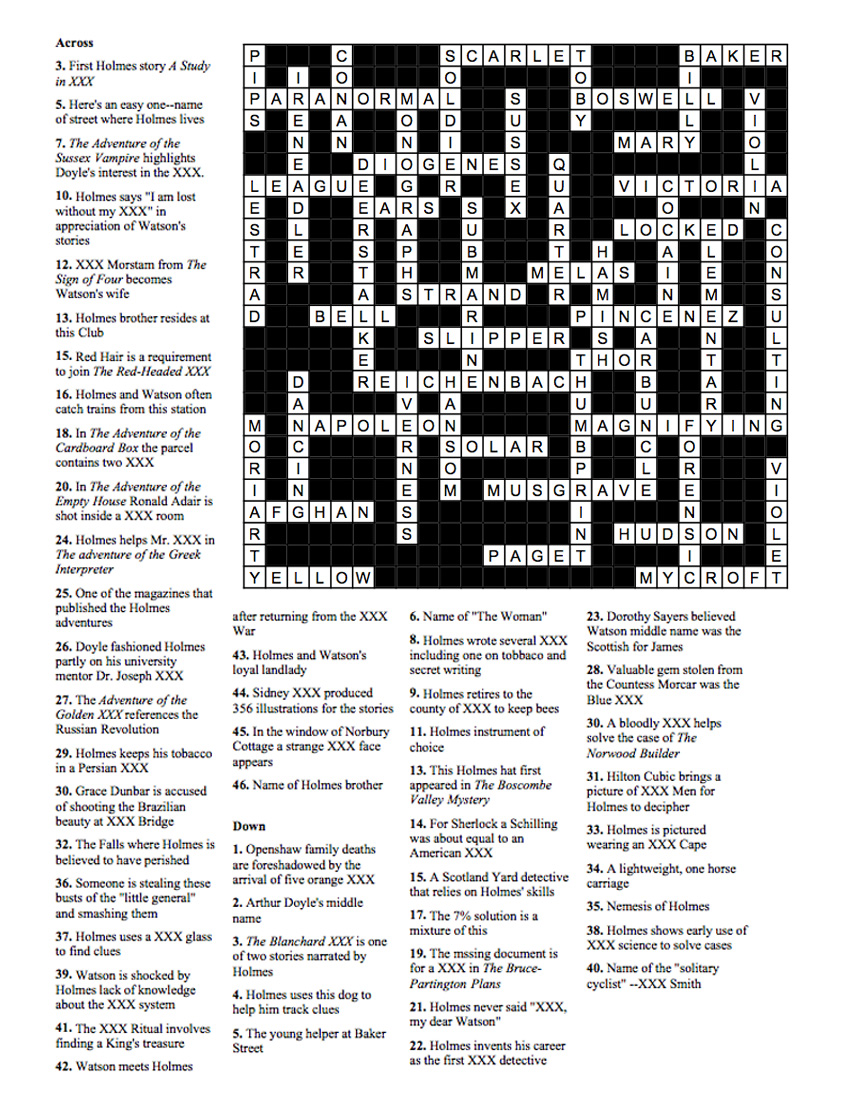
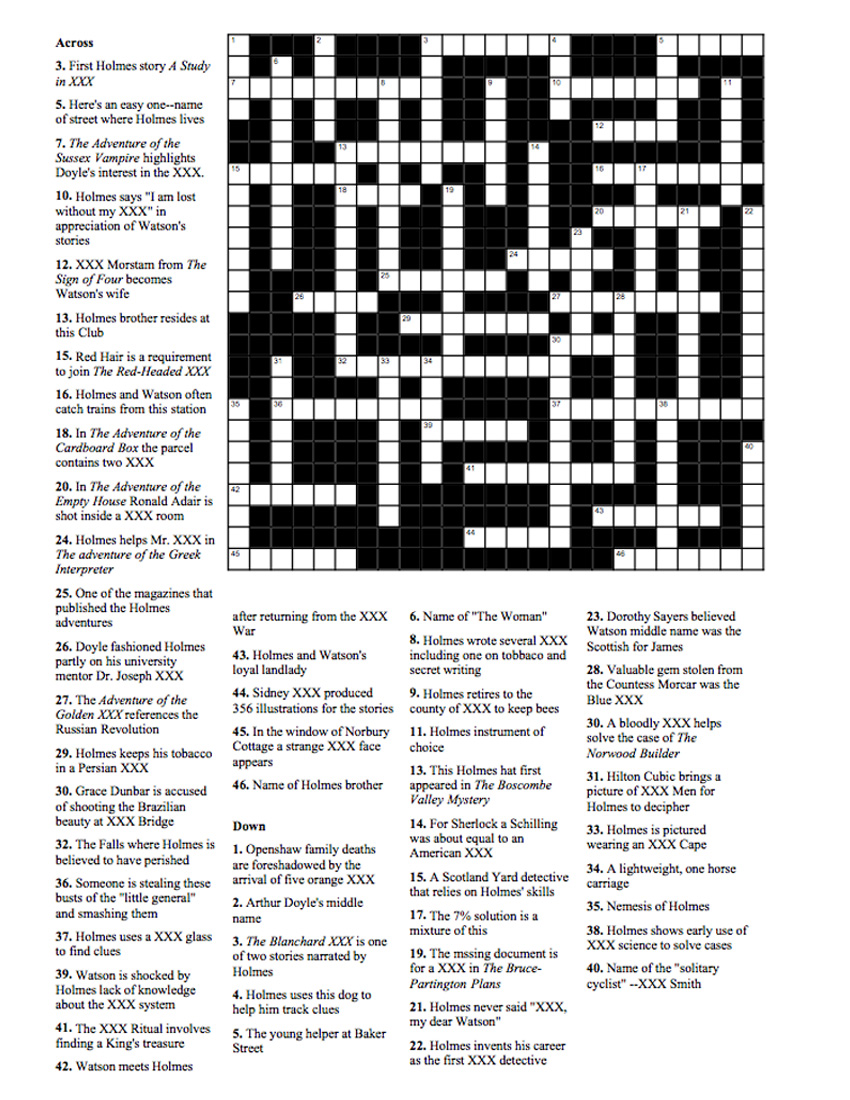
We’ve been discussing the role of Watson in the last couple of blogs, but how much do you know about Sherlock Holmes. Here is your chance to test your knowledge. Solution will be posted next week.
In the last blog, we ended with Holmes saying, “I am lost without my Boswell” referring to Watson’s efforts to document his adventures. It is Watson’s descriptions of Holmes methods and his detailed information about the cases that we rely upon to help us solve the crime. As readers we would be lost without our Watson as chronicler.
And in this blog just like in the stories we’ll let Watson tell the tale. We’ll learn more about his writing from his stories.
How does Watson get started as the teller of tales about Holmes? It officially begins at the end of the first story, A Study in Scarlet, when Watson is annoyed that Scotland Yard is getting credit for the case that Holmes solved
“It is wonderful!” I cried. “Your merits should be publicly recognized. You should publish an account of the case. If you won’t, I will for you.”
“You may do what you like, Doctor, he answered.
Although Holmes gives Watson permission to chronicle the stories, he is often critical of Watson’s presentation. Holmes feels that a story shouldn’t be weaved around characters
and plot but around the facts of his scientific observations and deductions. Holmes states his opinion in The Sign of Four.
Honestly, I cannot congratulate you upon it. Detection is, or ought to be, an exact science and should be treated in the same cold and unemotional manner. You have
attempted to tinge it with romanticism, which produces much the same effect as if you worked a love-story or an elopement into the fifth proposition of Euclid.
Watson continues to produce stories in the format the reader enjoys, but he does provide insight into how Holmes works and his methodology. Also in A Study in Scarlet Watson points out Holmes ability to reason analytically.
In solving a problem of this sort, the grand thing is to be able to reason backward. That is a very useful accomplishment, and a very easy one, but people do not practice it much. In the everyday affairs of life it is more useful to reason forward, and so the other comes to be neglected. There are fifty who can reason synthetically for one who can reason analytically.
The next question is how does Watson select the stories? Watson explains in The Yellow Face, that he tends to select those cases where Holmes has been successful in his deductions.
In publishing these short sketches based upon numerous cases in which my companion’s singular gifts have made us the listeners to, and eventually the actors in, some strange drama, it is only natural that I should dwell rather upon his successes than upon his failures. And this is not so much for the sake of his reputation—for, indeed, it was when he was at his wit’s end that his energy and his versatility were most admirable —but because where he failed it happened too often that no one else succeeded, and that the tale was forever without a conclusion. Now and again, however, it chanced that even when he erred the truth was still discovered.
He indicates in The Adventure of the Veiled Lodger that the selection of materials benefits the clients because he protects “that the honour of their families or the reputation of famous forebears may not be touched, have nothing to fear.” In this same story Watson makes another reference to the vast number of cases he has at his disposal.
When one considers that Mr. Sherlock Holmes was in active practice for twenty-three
years, and that during seventeen of these I was allowed to cooperate with him and to keep notes of his doings, it will be clear that I have a mass of material at my command. The problem has always been not to find but to choose. There is a long row of year-books which fill a shelf, and there are the dispatch-cases filled with documents, a perfect quarry for the student not only of crime but of the social and official scandals of the late Victorian era.
Holmes also compliments Watson on his story selection in The Adventure of the Abbey Grange. Holmes is discussing that every time policeman Hopkins calls him in on a case it has been justified and Watson has written about all of them. But Holmes once again notes that Watson is a story teller and not properly documenting his scientific work.
“I fancy that every one of his cases has found its way into your collection, and I must admit, Watson, that you have some power of selection, which atones for much which I deplore in your narratives. Your fatal habit of looking at everything from the point of view of a story instead of as a scientific exercise has ruined what might have been an instructive and even classical series of demonstrations. You slur over work of the utmost finesse and delicacy, in order to dwell upon sensational details which may excite, but cannot possibly instruct the reader.”
But here I take issue with Mr. Holmes, Watson does instruct the reader. He is excellent at describing the details and methods of Holmes. His instruction allows us to investigate the
crime and occasionally discover the solution along with the master detective.
And the tables are turned on Mr. Holmes when he takes up the pen to relate a story in his own hand. In The Adventure of the Blanchard Soldier. Holmes comments on how
difficult a task it is to record the story.
Perhaps I have rather invited this persecution, since I have often had occasion to point out to him how superficial are his own accounts and to accuse him of pandering to popular taste instead of confining himself rigidly to facts and figures. “Try it yourself, Holmes!” he has retorted, and I am compelled to admit that, having taken my pen in my hand, I do begin to realize that the matter must be presented in such a way as may interest the reader.”
Oh thank heavens for Dr. John H. Watson’s approach as story teller and not as scientific writer of Holmes adventures. It is the characters, the descriptions and the puzzles that keep us engaged and trying to match wits with the great detective. As readers we don’t mind an occasional dose of the scientific but its Dr. Watson’s romantic approach that entices us to want more of Sherlock Holmes.
In a previous blog we discussed the role of Seconds in mysteries. Since Sir Arthur Conan Doyle’s Dr. John Watson really defines the role of an assistant he deserves his own blog. In fact he deserves two. So here is part one of our discussion of John Watson’s role as
Sherlock’s Second.
Previously we defined some common characteristics of Seconds. First, the personality of the Second is often in stark contrast to the detective and his intelligence is not as superior as his detective. Next, the Second may occasionally point out flaws to help the reader
better understand the detective. However, the Second is a staunch defender of the detective including putting his own life on the line. Third, our Second may act as a red herring by offering incorrect theories. Fourth, we rely on the Second for information about the case. Now, let’s take a closer look at Dr. Watson and his role.
If you are only familiar Nigel Bruce’s movie portrayal of Watson opposite Basil Rathbone’s Sherlock you may have the impression that Watson is a buffoon who is always on the verge of causing disaster. However, Watson is an intelligent and dedicated doctor who served honorably in the Fifth Northumberland Fusiliers as an assistant surgeon. However
we learn in the first story, A Study in Scarlet, that Watson is not the hero of the tale.
Watson begins creating his secondary role when he describes his service in the Afghan war, “the campaign brought honors and promotions to many, but for me it was nothing but misfortune and disaster.” Hit in the shoulder by a bullet then stricken with fever Watson is sent back to England to recover. His funds are limited and he needs to find inexpensive lodgings and this need leads him to Holmes.
Holmes is working in the laboratory at a hospital but we learn that he is not studying medicine. He is doing experiments for personal knowledge.
Watson describes Holmes as a little too scientific to the point of “approaching cold-bloodedness.” We are told he would give a friend a pinch of alkaloid not out of malevolence but in the spirit of inquiry. Watson adds that Holmes has no specific profession, but a passion for definite and exact knowledge.
We learn that Holmes knowledge of literature, philosophy, and astronomy are nil and his
knowledge of politics is feeble while his knowledge of chemistry is profound. Botany is variable since he knows about opium and poisons, but nothing about gardening. He is an expert boxer and swordsman and has a practical knowledge of British law. He is good at the science of deduction and analysis, but lacks social skills.
In contrast, Watson easily handles social situations especially when women are involved. He often provides valuable medical information for Holmes. He is intelligent and maintains a general knowledge about many subjects. However, we learn Watson isn’t as good as Sherlock with observation and deductive powers.
Even though Watson has responsibilities as a doctor and later as a husband he is always willing to accept an adventure with Holmes and act as his guardian. Holmes regards Watson as “having someone with me whom I can thoroughly rely.” It’s Watson who keeps his trusty pistol handy in case he needs to protect Holmes. However, Holmes is also concerned about Watson and we have a rare glimpse of his reaction when Watson is shot in The Adventure of the Three Garridebs.
In an instant he had whisked out a revolver from his breast and had fired two shots. I felt a sudden hot sear as if a red-hot iron had been pressed to my thigh. There was a crash as Holmes pistol came down on the man’s head. I had a vision of him sprawling upon the floor with blood running down his face while Holmes rummaged him for weapons. Then my friend’s wiry arms were around me, and he was leading me to a chair.
“You’re not hurt, Watson? For God’s sake, say that you are not hurt!”
It was worth a wound—it was worth many wounds—to know the depth of loyalty and
love which lay behind that cold mask. The clear, hard eyes were dimmed for a moment, and the firm lips were shaking. For the one and only time I caught a glimpse of a great heart as well as of a great brain. All my years of humble but single-minded service culminated in that moment of revelation.
Watson’s remarks also add definition to the role of a Second when he mentions his “humble but single-minded service.” The Second remains in the background to the great detective but is always available for support and protection.
In the early stories, Holmes is often disappointed with Watson’s abilities at deduction. In fact, Watson’s deductions are often false clues. For example in The Adventure of the Solitary Cyclist Holmes belittles Watson’s location for observing the cyclist.
Your hiding-place, my dear Watson, was very faulty. You should have been behind the
hedge, then you would have had a close view of this interesting person. As it is, you were some hundreds of yards away and can tell me even less than Miss Smith.
Holmes then points out that instead of following a clue from a real estate sign he should have gone to the local pub and listened to gossip. But as the stories continue, Holmes is pleased that Watson’s powers of observation are improving.
And the reader relies on these observations from Watson and other Seconds to tell the story. We know Watson will ask Holmes the questions we want answered about the case. Even Holmes comments about Watson chronicling of the stories when he says, “I am lost without my Boswell.” It is Watson’s accurate descriptions of characters, locations and clues that allow us to solve the case along with Sherlock.
In the next blog we’ll take a closer look at the writings of Dr. John Watson about his good friend Sherlock Holmes.
We can always find reasons for murder, especially in our favorite mystery books. How did you do? Did you find all the words?

Some of my fondness memories as a little girl were the times I spent watching mystery movies with my Mom. It seemed that so many of those early black and white movies had an element of fog in them. I clearly remember the Basil Rathbone/Nigel Bruce films where Holmes and Watson walk through the fog as the opening credits role. And fog was used throughout those films to create suspense.
Fog Adds a Sinister Element
Now, I do know fog was utilized in many low budget mystery movies as a way to cut costs. Start the fog machine and there was no need for elaborate sets. But aside from saving money, you must admit fog does add a sinister element to any movie.
The use of fog in both books and movies makes the plot a little darker. In the fog characters find themselves in dangerous situations where evil can hide in a fog encased street and murderers can effectively escape from capture.
Newer Mysteries
Today’s mysteries tend not to use fog. They use other elements like snow storms and extreme heat. For example, Diane Mott Davidson’s sleuth Goldy Schultz is often hampered by snow storms in Aspen Meadows where her crimes take place. One of Carol Higgins Clark’s books Iced also takes place in Aspen where the heavy snow makes it tough to catch the killer. And Joanna Pence’s book Red Hot Murder takes place in the dessert where there is no definitely no fog.
But I still like fog. Fog is a weather element that has a unique way of building suspense. Check out the following description from Arthur Conan Doyle.
The Hound of the Baskervilles
Every minute that white woolly plain which covered one-half of the moor was drifting closer and closer to the house. Already the first thin wisps of it were curling across the golden square of the lighted window. The farther wall of the orchard was already invisible, and the trees were standing out of a swirl of white vapour. As we watched it the fog-wreaths came crawling round both corners of the house and rolled slowly into one dense bank, on which the upper floor and the roof floated like a strange ship upon a shadowy sea.
This first description sets the scene before the appearance of the hound. You’ll see what I mean as you read the next description of the hound racing through the fog towards Holmes and Watson.
There was a thin, crisp, continuous patter from somewhere in the heart of that crawling bank. The cloud was within fifty yards of where we lay, and we glared at it, all three, uncertain what horror was about to break from the heart of it. …I sprang to my feet, my inert hand grasping my pistol, my mind paralyzed by the dreadful shape which had sprung out upon us from the shadows of the fog. ..Never in the delirious dream of a disordered brain could anything more savage, more appalling, more hellish be conceived than that dark form and savage face which broke upon us out of the wall of fog.
Can you visualize it? Can you see the wall of fog and then the face of the horrible hound becoming visible? We know what’s going to happen but the fog builds an intensity that makes it even more suspenseful.
Here’s another example of the use of fog. Sam Spade’s partner Miles Archer is killed in the second chapter which is entitled “Death in the Fog.” The title starts us imaging the visual of what is about to happen. While Hammett’s descriptions are short they adequately set the scene. This is the description of Spade’s room just before the call about his partner’s murder.
The Maltese Falcon
“Cold steamy air blew through two open windows, bringing with it half a dozen times a minute the Alcatraz foghorn’s dull moaning.”
You can feel the air and hear the fog horn as you read this description. Then we get a single sentence when Spade arrives at the murder scene.
San Francisco’s night-fog, thin, clammy, and penetrant, blurred the street.
This one sentence sets the entire scene. We already know from the chapter title what happened and we know it’s murder.
Here is one more fog reference, this time from Agatha Christie.
The Pale Horse
Father Gorman walked back through the gathering twilight. There would be fog tonight, it was growing denser rapidly. He paused for a moment frowning. Such a fantastic story…How much of it was born of delirium and high fever?
This particular reference to dense fog not only describes the weather but the state of Father Gorman’s mind as he reflects on the confession he just heard from a dying woman. In the next fog reference, Father Gorman is moments away from his own death and an eyewitness describes the last sighting of the priest.
The fog was coming on and there weren’t many people about. I’d gone to the door to look at the weather; thinking to myself the fog was coming up fast. The weather forecast had said it would…A little way behind him (Father Gorman) there was another man…What with the fog coming up. I lost sight of them both almost at once.
We have lost sight of Father Gorman in the fog, but we know what is going to happen. We know what the fog is going to hide from us.
Do you have a favorite fog reference? Somehow events occurring in fog seem so much more suspenseful. Maybe fog is old fashioned and not the most popular weather element at the moment, but you know—I miss the fog in mysteries.
References:
The Complete Sherlock Holmes, Dorset Press, 1988; Maltese Falcon, Dashiell Hammett, Vintage Crime/Black Lizard Vintage Books, August 1992; The Pale Horse,(1961) Agatha Christie, Harper Version
Mystery Books continue to be one of the most popular genres in publishing. Have you ever wondered what makes mystery books so popular and different from other novels? In order to answer this question let’s start by looking at the elements all good books have in common.
Plot is technically how a story is organized. The organization might use chronological events, a series of stories, flashbacks or different voices. However, plot is really about the events that move the story forward to the conclusion. The events and how they intertwine with the other elements keeps the reader engaged.
Characters need to be believable and that means they are well rounded. While we love our heroes, they are not perfect and have flaws. And villains are not all bad and have redeeming elements to their personality.
We need to identify with the characters. Have we been in the same circumstance, have we faced the same decisions or at the very least can we understand the character’s situation? And we like our characters to have something unique about their personalities. We all know Miss Marple knits, Jim Qwilleran drinks Squunk water, Kinsey Millhone likes peanut butter and pickle sandwiches and Sherlock keeps his tobacco in a slipper.
Dialogue helps the story in two ways. First, it gives insight into the personality of the
characters based on what they say and how they say it. Second, dialogue helps to move the story. Dialogue provides answers and insight into what is happening or about to happen.
Setting whether it’s a fictional or a real location needs to be believable. Can the reader
visualize riding or walking through the streets of a particular location? And if it is a real town are the names of the streets accurate and the sites mentioned located in the right spot.
But setting is more than a physical location or backdrop for the story. Setting provides a look into the culture of the characters in the story. What people say and how they respond can be directly related to where they live. Does the banker in a big city react the same way as a fisherman in a small coastal village or the cattleman on a ranch?
Action/Conflict helps to move the plot. Something has to happen to take us from one scene to the next. Is it finding the secret room, a fight between two characters or a struggle to do the right thing? As readers we get involved with the conflict—we insert our desire for how we want the conflict to end and we root for our favorite character to prevail.
What does a mystery book offer that is different from other novels?
It’s the puzzle. Each mystery has a puzzle that must be solved. The puzzle has two essential elements—the crime that is the centerpiece of all mysteries and the clues that guide us and the detective to the solution of this crime.
In a mystery, plot, characters, dialogue, setting and action/conflict are all designed to help the reader gather the puzzle pieces. Then we are asked to put these pieces together in a
logical fashion to form a complete picture and solve the case. It is the challenge of solving the puzzle and figuring out “whodunit” that keeps the mystery reader engaged.
So the next time you want to go to sleep but you can’t put the mystery book down give credit to the puzzle. It’s our wanting to solve the puzzle that keeps us turning the pages. It’s the puzzle that makes mystery books different and exciting. It’s the puzzle that helps them remain a top selling genre.
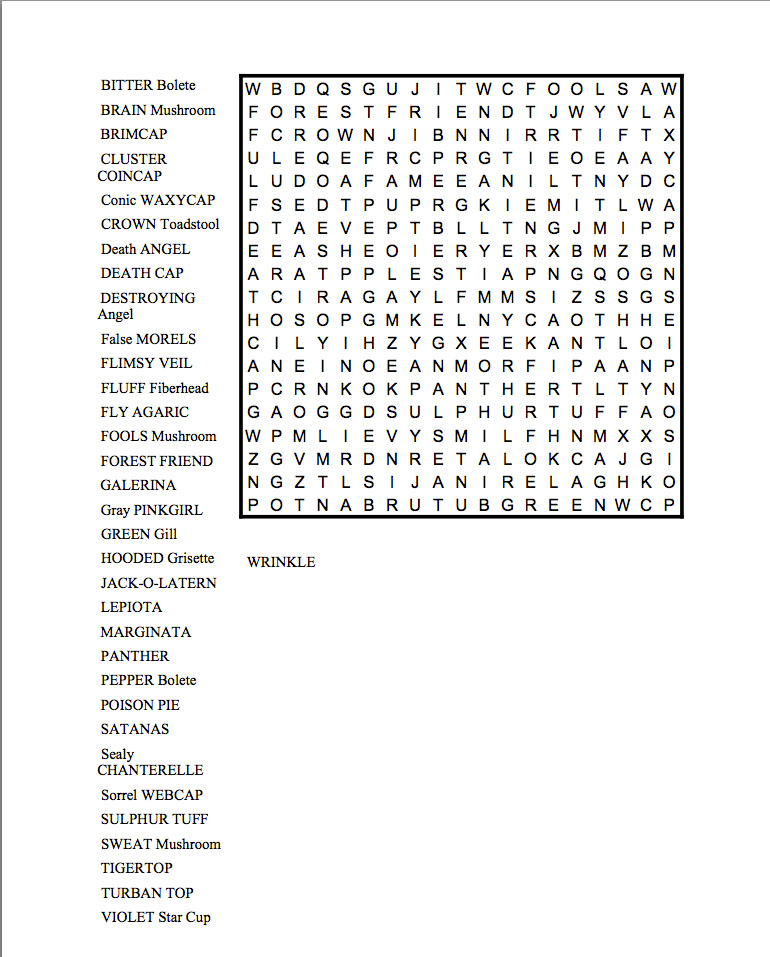
Did you find all those pesky little killer fungi? Here’s the solution.

Be sure you trust your chef before you eat his next tasty little dish containing mushrooms! Enjoy your food and the puzzle! The solution will be posted next Tuesday.
In Part One, we looked at the creation of the Ellery Queen mystery books and how they are an important part in the development of the American detective genre. Now let’s take a closer look at the Ellery Queen stories and why they are unique and a must read for mystery lovers.
Golden Age of Mysteries
Keeping with the format of Golden Age Mysteries, Ellery Queen is not always involved in the action. Many of the scenes focus on characters and potential suspects and much of the narration comes from these people as they interact with each. These interactions help to reveal possible clues.
Ellery might be off stage chasing down a detail, but later he reappears to share his discoveries and to learn what others have found. Ellery is a sharp observer and presents everything he discovers to the reader.
In Golden Age mysteries the clues are the most important element in the story because the detective cannot use intuition or guesswork to solve the crime. The clues must provide the answers.
We relate to Ellery because in many ways he is just like us. As readers we are gathering clues and following suspects to find who committed the crime and so is Ellery. Our goal is to figure out who did it before Ellery provides the solution.
A Mystery Jigsaw Puzzle
Ellery Queen mysteries are just like jigsaw puzzles. The books methodically lay out the puzzle pieces (clues) so we can make an informed decision about who did it. Just like a jigsaw puzzle the last piece fits only in one place and all the clues point only to one possible culprit.
The Reader Challenge
Another unique feature of the early Ellery Queen mysteries is the Reader’s Challenge where Ellery asks us to go head to head with him to solve the case. Here is a portion of the Readers Challenge from Halfway House (The Langtail Press, 2011, originally published 1936)
For many years I have been a voice crying in the wilderness—I trust not vainly—beseeching readers to repress heroically their guessing proclivities and play the game scientifically. It’s harder, but immeasurably more fun.
Why not begin with the problem of Joseph Kent Gimball’s murder?
At this point in the story you are in possession of all the facts needed to build up a complete and logical solution of the crime. Your job is to spot the vital clues, assemble them in rational order, and from them deduce the one and only possible criminal. It can be done; it has been done as you will see.
If you fail, of course, you can always fall back on the old reliable guesswork. If
you succeed, let me know about it.
Ellery reminds us that all the clues have been presented and we have been privileged to the same information he has. Therefore as reader’s we should arrive at the correct solution. Later books don’t specifically challenge the reader, but the process is still the same with all the clues pointing to only one possible solution.
All is Revealed
Following his reader’s challenge in Halfway House, Ellery has all the suspects return to the scene of the murder to help recreate the events. As the facts are revealed (don’t worry I won’t reveal who did it) the murderer makes a run for it. However what is interesting is the murderer’s name still isn’t revealed in this chapter. Of course if you have assembled your puzzle pieces in a logical order, as Ellery suggested, you know who did it. But just in case you missed the correct answer, in the next chapter Ellery takes the reader step by step through all of the clues. He explains how each of the possible suspects is gradually eliminated until there is only one person left—the killer.
Don’t Forget Ellery Queen
Ellery Queen mysteries are period books and a little dated but still a great read. If you haven’t read an Ellery Queen book, check out your local book store or jump on Amazon or B&N and order an Ellery Queen. As I mentioned in the last blog when you are finished, think about donating your copy to the local library. We want to make sure Ellery Queen mysteries continue to remain available for our fellow mystery lovers.
I was straightening out some book shelves the other day and I discovered an old audio copy of an Ellery Queen mystery. I had forgotten about Ellery Queen. It’s been a long time since I ventured into his world, so I decided to stop by my local library and borrow a
couple of Ellery Queen mysteries.
At the library I discovered something I didn’t expect. My local branch had no Ellery Queen books–NONE. When I discovered this I asked if a book could be transferred from another branch. My wonderful librarian checked the computer and we found there were no Ellery Queen books in the entire county library system. “Don’t worry,” she said, “we belong to a multi-state association of libraries that share books and we can request Ellery Queen mysteries from them.” I was informed this request would take two weeks, but less than a week later I received a phone call informing me that the only available copies of Ellery Queen books were so old they were no longer available for sharing.
Looking for Ellery Queen
I continued to think positively. I live only a few miles from a very large Barnes and Noble, so I decided I would purchase a couple of Ellery Queen books to add to my library. But alas, Plan B was equally a failure as B&N had no copies in the store. Now I was
determined! I returned home and jumped on Amazon and was finally able to purchase Ellery Queen books on line. I solved my problem but the lack of Ellery Queen books in the libraries and at the book stores is not a good omen for mystery fans.
Ellery Queen’s Beginnings
For those of you who don’t know, Ellery Queen is both a fictional character and a pseudonym for two cousins, Frederic Dannay and Manfred B. Lee who authored the books. They wrote over 30 novels, several short story collections and founded the Ellery Queen Mystery Magazine in 1941 which continues to be published. They also wrote four books under the pseudonym Barnaby Ross about a detective called Drury Lane.
Ellery Queen was created by the two cousins in 1928 as an entry in a magazine writing contest. They won but a change in ownership at the magazine caused the prize to be awarded to another contestant. So the cousins submitted their entry to a publisher and the first Ellery Queen book the Roman Hat Mystery appeared in 1929.
Golden Age of Mysteries
Many devotees of the mystery genre feel that along with Edgar Allen Poe, the cousins developed the American detective format more than any other writers. Ellery Queen represents the classic detective in whodunits from what was called the “Golden Age” of the mystery novel.
With books from this period the reader discovers the clues along with the detective and has the same opportunity as the detective to solve the puzzle. The clues are carefully
presented so that by the end of the story there is only one logical solution to the crime. There may be red herrings but no information is kept from the reader and all suspects are on the scene and available for questioning.
In the next blog I’ll discuss more about Ellery Queen stories and what makes them unique. In the meantime if you haven’t read an Ellery Queen, by all means use the Amazon button on this site or jump on the B&N website and order yourself a great read. And when you’re
finished, think about donating your copy to a local library. Because this is one mystery series we don’t want to forget.
Well–how did you do? I’m sure you did great! Just in case you want to check one or two of your titles here are the answers.