How many mystery book titles can you identify? This puzzle is a bit more challenging so you have two weeks to complete. The solution will be posted on March 6th. Have fun!
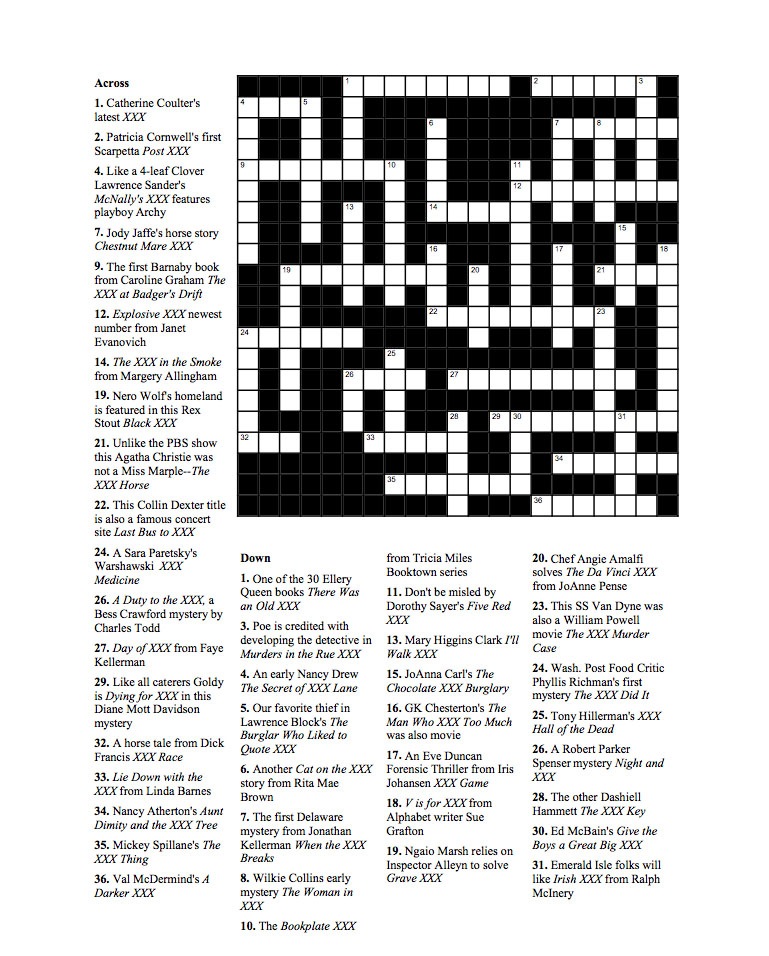
How many mystery book titles can you identify? This puzzle is a bit more challenging so you have two weeks to complete. The solution will be posted on March 6th. Have fun!
What is a red herring? On the simplest level, it is a kipper or a herring fish that is heavily salted and smoked. As a result of this process the fish turns red and has an extremely strong smell.
How did the term red herring come to mean throwing one off the scent? Some will dispute the origin, but I will share the story because it seems to make sense.
It is said that red herrings were used to train young hunting dogs to follow a scent. Once the dogs were trained to follow the strong fish smell the lighter scent of a fox or a rabbit was substituted. As a final step in the training the red herring was crisscrossed through the animal scent to throw the dogs off. When the dogs could ignore the red herring and follow the true scent they were ready to hunt.
In mysteries a red herring refers to a clue or even a character designed to throw the reader and the detective off the scent of the real culprit. A mystery often cited for its red herring is
Agatha Christie’s Murder on the Orient Express. In fact, Hercule Poirot discusses the red herring during his solution of the case:
“Further to confuse the issue a red herring was drawn across the trail—the mythical woman in the red kimono. Again I am to bear witness to this woman’s existence. There is a heavy bang at my door. I get up and look out—and see the scarlet kimono disappearing in the distance.”
However, I think the Christie story goes beyond the incident of the red kimono. Unlike some stories with a single red herring, I think the entire story is about red herrings designed to mislead Poirot and that’s what makes this mystery unique. Let’s take a closer
look at some of Christie’s red herrings.
Many of the other clues like the pipe cleaner or the dainty embroidered handkerchief cast suspicion on the passengers. However, the red herrings are directing Poirot to a stranger who has entered the train disguised as conductor and somehow escaped–perhaps as a woman wearing a red kimono. But just like the hunting dogs, Poirot ignores the strong smell of the herrings and finds the true scent to solve the case.
What’s your favorite mystery with a red herring?
The amazing thing about the Midsomer Murder series is that the murders are all so civilized.
Midsomer murder mysteries are the creation of Caroline Graham and the stories all take place in English villages which are part of the county of Midsomer. Perhaps it’s the gentle setting of the English village with its lovely shops where riding one’s horse through village streets is an accepted pastime that adds to the atmosphere of civility.
Caroline Graham wrote seven books and then decided to stop writing the series. Five of the books were developed by British television for Midsomer Murders which has continued to produce more than 60 episodes based on the original characters.
What makes these mysteries so successful with a loyal following of both readers and television watchers? It’s the characters. They are a little odd, a little outside of the norm, but still believable. Miss Graham once said in an interview that her books are character,
not plot driven. Part of the intrigue in her books is that the murders often appear to be unrelated until the end when we learn of a hidden relationship between the various characters. Ms. Graham also stated that the characters, alive or dead, are the most important element of her stories.
Speaking of the dead–there is the matter of the murders. This apparently sweet English writer is not the least bit shy about murder. Victims are shot, stabbed, hanged, poisoned,
drowned and even beheaded to mention a few methods. And there is usually more than one murder in each story. In the first book The Killings at Badger’s Drift there are four murders, three suicides and an incestuous love affair. In one of the television episodes, Death’s Shadow, the local vicar kills five people while continuing to perform his churchly duties. When the reverend is revealed he promptly commits suicide by jumping from the top of the church.
All these murders, while brutal, remain very civilized. After the victim is discovered, Chief Inspector Tom Barnaby and his sergeant arrive on the scene to solve the crime. Once they start the investigation, police procedures are carried out in a very orderly process. These
procedures and the sharp detecting skills of Barnaby eventually uncover the culprit.
But when the murderer is exposed there is no American style shoot-out or high speed car chase. The murderer admits to the crime and usually offers a polite confession. This confession may even occur over a nice cup of tea. Additionally, Barnaby while dealing with gruesome crimes has a very normal family life with wife Joyce and daughter Cully. Throughout the story we get a glimpse of his home life which provides a nice balance to the murder investigations.
The murders in Caroline Graham books appeal to the sense of the macabre within all mystery readers. We love a murder. And if there are two, three, or more murders I think we accept them because they occur in a civilized setting. Plus, when we finally hear the
confession the murders make perfect sense.
What lovely opposites! Brutal murders and odd characters all assembled in a pleasant English village with polite confessions. How very civilized!
I’m sure one of the holiday gifts received by many households this season included the game of Clue.
This popular murder mystery board game was developed in 1944 by Anthony E. Pratt, an English solicitor’s clerk. He called the game Murder and sold the idea to Waddingtons an English company who changed the name to Cluedo and introduced it in 1949.
Waddingtons also licensed the game to Parker Brothers who Americanized it including changing the name to Clue.
After more than sixty years, the game continues to be published by Hasbro. If you haven’t played Clue lately, dust off your copy, or invest in a new purchase (now available in several formats) and treat yourself to this great game.
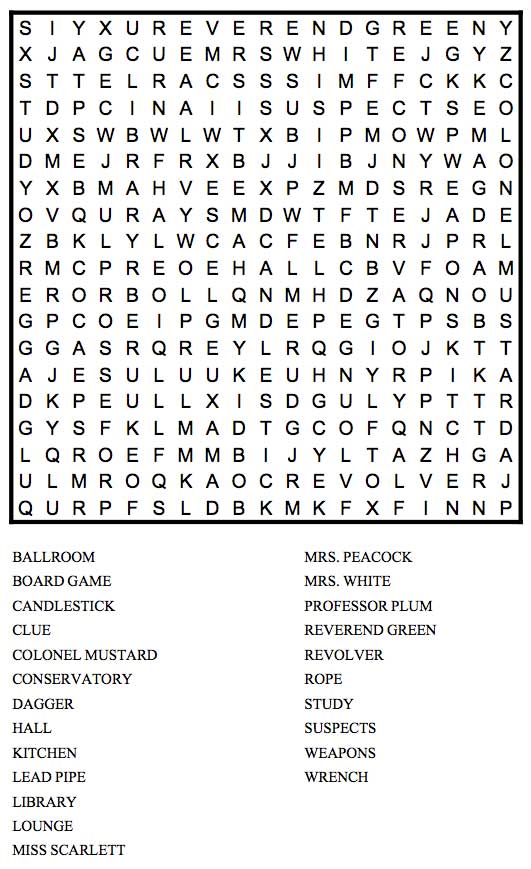
In the attached word search see if you can find the characters, rooms and weapons from the game.
There are so many mystery novels that team the main detective with a second individual. For example, the Second might be the detective’s sergeant, a friend, an associate, a member of the police department or a husband or a wife. This person is an able bodied assistant that may help or may even act as a foible to the investigation of the detective.
For several years I lived in a town with a robust textile industry and the local residents could purchase items at company stores where “seconds” were sold. At the entrance to the store a posted sign described seconds as:
an item containing a slight flaw when compared to the original product. This slight flaw does not affect the ability of the product to perform or the overall quality of the product.
Does this same definition apply to the Seconds in mysteries? Do Seconds possess a slight flaw as compared to the detective?
When I take a closer look at Seconds in mysteries I find three recurring characteristics.
First, the person is a staunch defender of their detective and this defense takes two forms. Seconds may occasionally disagree or point out flaws in the person they assist. This information can help the reader understand the detective by learning about their habits and quirks. But this disclosure about the detective’s flaws is reserved for the Second alone. They do not allow others this same liberty of pointing out weaknesses in their detective. And when I say a staunch defender it goes beyond mere words. They will lay down their own life in defense of their detective. It’s often the Second that runs head first into danger to protect their detective.
The next characteristic of a Second is that their own personality is usually in stark contrast to the detective. If they are interested in dating and fascinated by the ladies like Archie Goodwin then detective Nero Wolf shows little interest in women. Hercule Poirot prefers staying inside and enjoying fine dining, excellent wines and a good book while his
associate Arthur Hastings prefers outdoor sports and fast cars. If the detective is a lover of opera like Morse then his Sergeant Lewis prefers pop music. If the Second is from the top of society like Nora Charles then our detective Nick Charles knows all the best people from society’s underbelly including the criminal element.
Third, our Second often acts as a red herring. They distract us by offering their own theories on who is most likely to have committed the crime. These suggestions often throw the reader off track, since their theory is not quite right. On the other hand, their theories seem to help the detective to focus and eliminate information where the logic doesn’t work.
Does the Second really have a slight flaw or are their characteristics designed to enhance
the image of the detective and the detective’s ability to solve the crime. Plus, where would the detective be without the defense and help of their Second.
What do you think? Do Seconds have a slight flaw? Do you have a favorite Second?
What was that? You’re asking–what about Watson? I agree –we can’t talk about Seconds
without mentioning Watson from Sherlock Holmes. However, since Watson in many ways defined the role of the Second I’m saving him for his own blog. Stay tuned!
What is the difference between the words investigate and detect? In mysteries there is a tendency to use these two words interchangeably, but according to the dictionary there is a difference.
If we go to Mr. Webster we find the following:
Based on these definitions, “investigate” describes what the police do. They take the fingerprints, do the autopsy, interview suspects, run lab tests and manage the research and analysis of what is discovered at the crime scene. The person who investigates is processing results and linking the findings to the solution. They use their scientific knowledge or police procedures to lead them to the person who committed the crime. Patricia Cornwell’s Dr. Kay Scarpetta is a great example of this approach to crime solving. She uses her scientific knowledge as a medical examiner to develop a profile of the murderer and then narrow her list of suspects.
On the other hand, the person detecting is gathering information. Each detail they discover is a piece of the puzzle. They may also talk to suspects and read the results of police reports but they tend to look at the pieces from a personal viewpoint as opposed to ascientific method.
The person detecting is a thinker who has the ability to logically connect the dots and form a picture from insignificant or unrelated pieces of information. There are occasions when this person disregards what appears to be a major piece of information or the theories of others because it does not logically fit the puzzle they are building.
Here is the part that is confusing but interesting. The person detecting can be a professional policeman. Colin Dexter’s Inspector Morse comes to mind. Morse is a policeman but he is not representative of the scientific side of police procedures. At crime scenes he sends his Sergeant in for a closer look at the dead body. In the morgue he prefers that the doctor provides the basic details and winces at the gory descriptions. He solves the crime by thinking through the information often while listening to opera or solving a cryptic crossword puzzle.
The person detecting can also be an amateur. What the amateur detective lacks in police procedures they make up with their knowledge of people and their local surroundings. And sometimes this knowledge is not always
appreciated by the people conducting the formal investigation. For instance, Christie’s Miss Marple is often viewed as a busy body old lady. But no matter what others might think, the amateur is able to assemble the clues until the solution is revealed.
So whether you’re a fan of the professional investigator or those who detect, grab a mystery and do some investigating and detecting of your own.
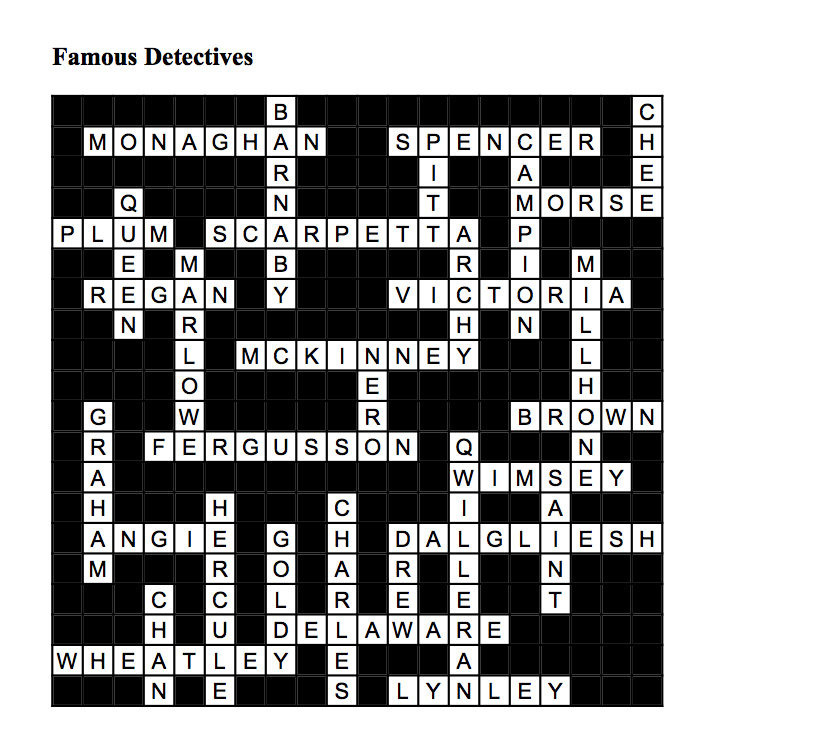
It’s time for another puzzle to test your mystery knowledge. How many detectives do you know? All answers are the detective’s last name unless noted. The solution will appear next week.
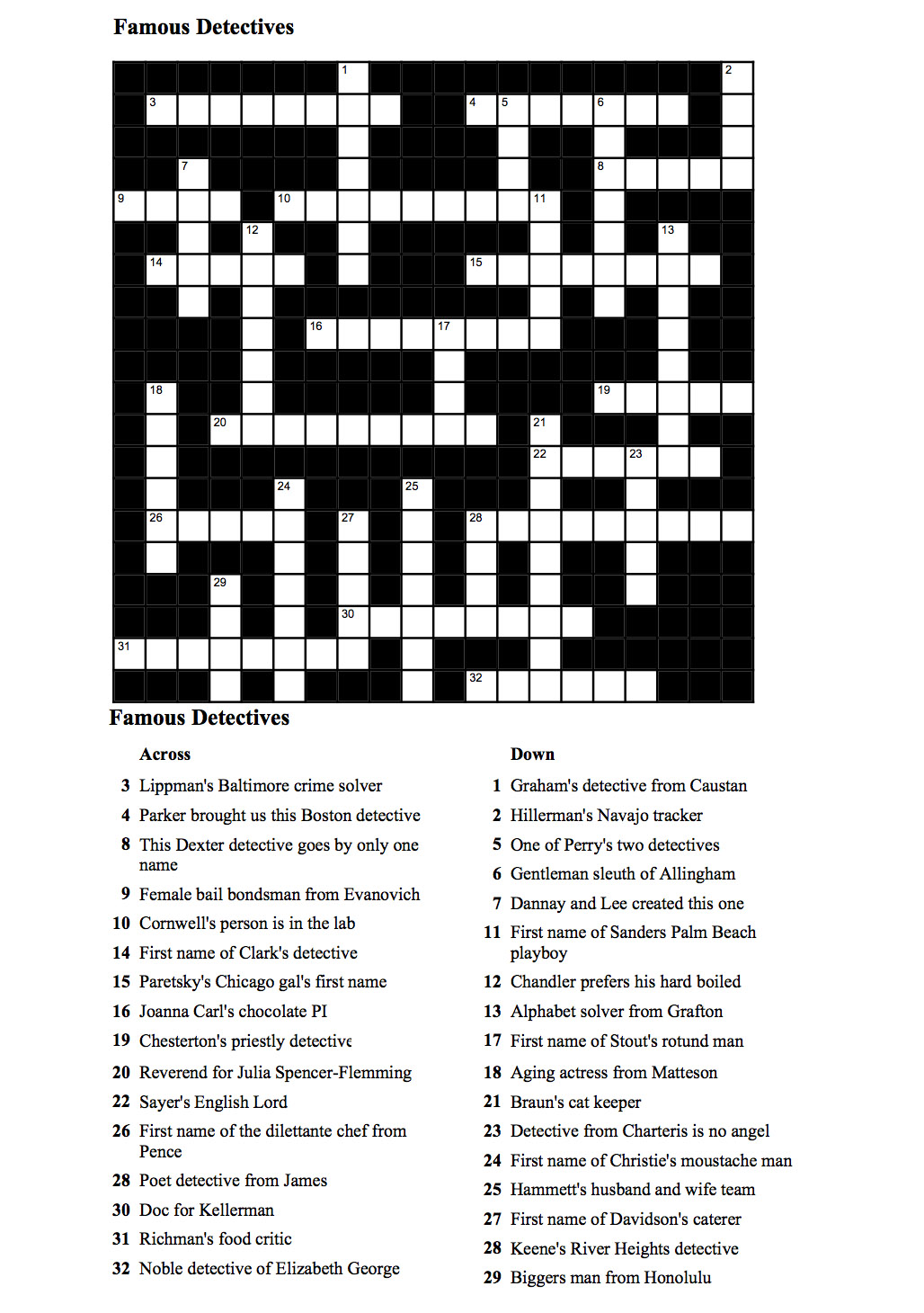
As a mystery reader, when I can identify with a particular element of a story it’s
a special treat. However, when I can personally experience something from a book,
that story really comes alive. I had one of these experiences while reading Margaret
Truman’s, Murder at the Kennedy Center.
The location for Truman’s books is Washington, DC and there was a period in my
career when I was assigned for several months to a special project in DC. Instead
of lodging at one of the large commercial hotels in center city with all of
the traffic and tourists I preferred to stay at one of the smaller neighborhood
boutique hotels. My choice was the River Inn located in the residential section
of Foggy Bottom.
After a long day at work, it was my custom to relax with a mystery book before
deciding what to do about dinner. This particular evening I was enjoying Truman’s
murder mystery featuring her amateur detective Mac Smith.
I was reading the chapter where Mac is meeting a reporter to discuss the murder that
happened near the Kennedy Center. Imagine my surprise when I read the meeting was taking place at the Foggy Bottom Cafe located in the River Inn.
Mac and the reporter find the café very busy and comment the restaurant must be
giving away their famous onion rings. Since onion rings are a specialty of
the house they add an order to go with their drinks.
How could I resist? I picked up the phone, dialed room service and placed an order for onion rings. And before you ask, they were absolutely delicious and some of the best onion
rings I have ever eaten–even to this day.
This was one of the nice features of Truman’s books. She used actual Washington
locations. Her descriptions were so accurate that you could follow her characters
through the streets of Washington, enjoy a meal at the character’s favorite restaurant
and visit the same museums, hotels and tourist attractions where events in the book took place.
I also enjoy visiting and learning about the many fictional towns featured in other mystery books. In my upcoming book I use a fictional town. However, it was truly a fun experience to eat onion rings at the River Inn while reading a good Truman mystery.
I was wandering around my Barnes and Noble store recently and was struck by how large the mystery section was. In addition to almost two full rows of hardback mysteries, there were three long rows of paperback offerings. For me, seeing all those mysteries was like putting a meaty bone before a hungry dog.
It wasn’t just the number of books, but the variety of mysteries available that impressed me. By my count there were over twenty different kinds of books. But rather than list my twenty, let’s start our discussion with three basic categories–police procedurals, detectives and cozies.
In police procedurals the process within the police department is highlighted. The story focuses on the investigative techniques and the tools policemen use to solve the crime. Parker’s Jesse Stone, Dexter’s Inspector Morse or Hillerman’s Leaphorn stories are some examples that give us a look at very different types of police departments. These books focus on the clues uncovered by the police process and how these clues lead to the solution.
I think Cornwell’s medical examiner Kay Scarpetta is another great example of a procedural—or is it a different category because it’s not about a policeman. See how the categories start to expand.
In the next grouping we have both hard boiled and soft boiled versions of detectives. Hard boiled stories are usually written in first person and from the perspective of the detective. These novels tend to be very graphic with lots of blood, guts and gore when describing scenes. Raymond Chandler’s Phillip Marlowe or Dashiell Hammett’s Sam Spade are examples credited with launching this category. But hard boiled is not limited to men, we have Paretsky’s Warshawski and Grafton’s Millhone representing the ladies.
The Soft Boiled Detective is still a professional detective, but the descriptions are less graphic and avoid the gore. Additionally we often get as much information about the detective’s lifestyle as the crime. I would offer Hercule Poirot or Nero Wolf as good examples. The stories can be written from the point of view of the detective, but that’s not a requirement. In Sherlock Holmes we rely on Watson for all the details.
Cozy mysteries are the last group and offer a large and diverse selection. Cozy mysteries take place in towns where anyone one of us could reside and the crimes are solved by amateurs. The amateur detective uses personal knowledge and life experiences like the quintessential Miss Marple who relies on the knowledge she learned in St. Mary Mead to solve the crime.
Cozies have many categories. We have mysteries solved by members of the clergy, lawyers, psychics, doctors, school teachers and the aristocracy. We have amateur detectives who own stores such as bookstores, chocolate shops and antique stores to name a few. We have bachelors, spinsters and couples helping to put the bad guys behind bars. One of my favorites is the culinary mystery which includes the preparation of food along with the clues. We even have animal detectives pawing through clues for a solution. And I’m sure I have left out many more examples. What about historical mysteries. Do they belong in their own category?
What’s my favorite category of mystery you ask? To be honest, I’m not sure I have one. I like all kinds of mysteries as long as there is a good story and a good puzzle to solve. But what about you–do you have a favorite type of mystery?
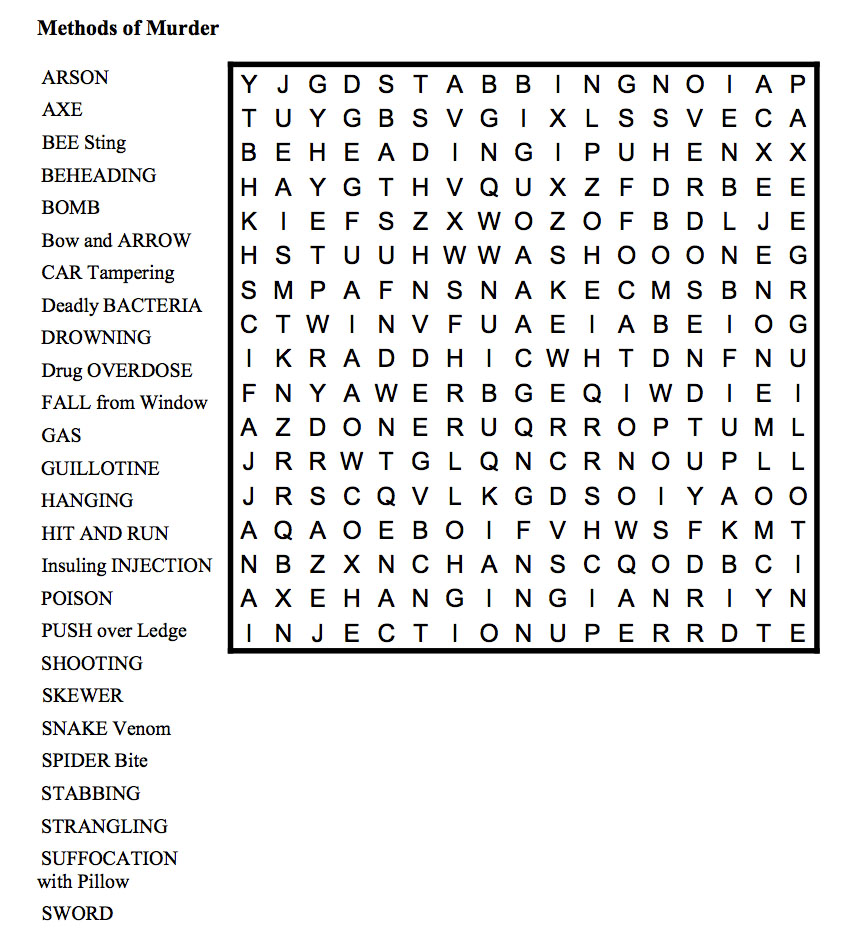
Here is the solution to last week’s word search
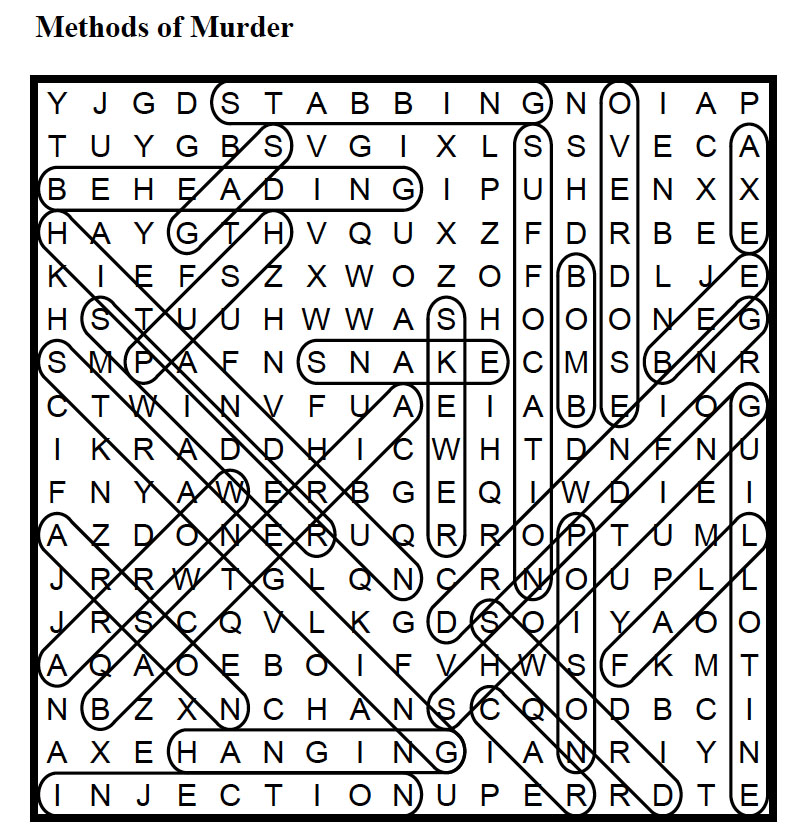
You will see that today’s blog is a puzzle.
Starting this week, I’m going to periodically post a mystery puzzle instead of a written
blog. The selections are either a word search or a crossword puzzle and of course the puzzles are all about mysteries.
In addition to testing your mystery knowledge, I hope they will be fun for you
to do.
In the odd week between blogs I will post the solution for the puzzle.
Enjoy the puzzles!
Millie
Mysteries–A Perfect Circle
I’ve often wondered why so many people, including me, love mysteries.
I think part of the reason may be that a good mystery is like a perfect circle. And I
suspect many of us take comfort in things that are logical and complete.
Why do I compare mysteries to a circle? Here’s my reasoning. At the beginning of the story there’s a crime. That’s the starting point of the circle and our mystery’s journey.
We move around the circle as we engage the plot with all its twists and turns. We
begin to meet the story’s characters but more importantly we’re introduced to our
detective. We closely follow our detective as information and clues are revealed.
As we gather facts, our hope is that we will complete the circle–uncover the
culprit–at the same time as our detective.
As simple as this may sound, there are some basic rules to follow when building a perfect circle. During our journey there should be no breaks in the circle. Clues cannot be left out. The writer should present the reader with everything needed to solve the crime. That doesn’t mean there isn’t an occasional red herring or a few pieces of information
that are presented to mislead. While these are designed to throw us off track, we
eventually cast them out of the circle and continue our progress around the
orb.
By the end of our journey, as Hercule Poirot would say, “all must be revealed.”
The circle is closed. There is a return to normal even if individual
circumstances have changed.
I like circles. I like the good feeling that comes from knowing that all the pieces fit together. I like mysteries for this same reason. Do you like circles?
Lilian Jackson Braun passed away on June 4, 2011, leaving behind a wonderful legacy of stories and 29 books in The Cat Who…” mystery series.
Lilian died at the age of 97 and the last book in her series was The Cat with 60 Whiskers published in 2007. This meant this wonderful lady was writing into her later years and according to her husband, there was yet another book that she regretted not finishing. What a great role model for the rest of us who have things to accomplish.
As a reader of Lilian Jackson Braun, I was fond of Jim Qwilleran, with his large moustache, his baseball cap and his two Siamese cats Koko and Yum Yum. In later books in the series, this unlikely trio shared a converted old apple barn in the town of Pickax in Moose County which readers learned was located 400 miles north of everywhere. And like the residents of Pickax, I looked forward to Qwilleran’s Qwill Pen column in the Moose Something newspaper.
While Qwilleran was the main character in the stories, most readers knew the true hero of the series was Kao K’o Kung (Koko). This special cat sensed in advance when something dire was about to happen. Koko was able to, not only predict the future, but lead Qwilleran to the clues that would help him solve the crime.
In addition to Koko’s help, Mr. Q. was always able to find out information and a bit of history from the locals because they liked his easy manner. He was a friend to most of the residents of this small town but he shared a special relationship with, Polly Duncan, the local librarian. Each night these two would share the day’s events in a phone conversation before retiring for the evening. At the end of the call, instead of saying goodbye they would say À bientôt.
So from those of us “down below” we say to Qwilleran, Koko, Yum Yum and of course Lilian Jackson Braun, À bientôt and thank you for a wonderful series of mysteries that have fascinated and entertained us for decades.
(If you would like to learn more about the writings of Lilian Jackson Braun, her books are available through many outlets. I find Amazon is a good source with many of her titles. You can check out her selection by clicking here: Lilian Jackson Braun)
Millie Mack
This first blog is just to say hello from Dark and Stormy Night Mysteries and to share our plans with you.
I’m a lover of mysteries, a reader of mysteries and a writer of mysteries. And I love talking about and sharing ideas about mysteries with old and new friends.
Some of my blogs will focus on a specific author or a specific book. I’ll also write about the characteristics of mysteries and what makes a good story. Other blogs may include my personal experiences or the thoughts and experiences from guest bloggers. And some blogs will be just for fun including mystery crosswords and word searches. But hopefully you will find all the blogs enjoyable.
New blogs will be posted every two weeks and I hope you visit often.
Millie